The changes aren’t loud or obvious. They’re happening in late-night conversations, quiet decisions, and the way men process the world. AI hasn’t replaced anything. It has simply slipped into places that were already empty.
Around 4 years ago, one of my friends did something unthinkable to impress his girlfriend. She is an avid reader and a poetry aficionado. And there comes my friend, a passionate gamer and a bibliophobe. They were going through a rough patch in their relationship, and to impress her, he sent her a piece of poetry; an original poem that no poet ever penned down. She was impressed, but I sensed something fishy. So, I confronted him, and it turned out to be written by Playground – an early product by OpenAI, launched in 2020. That was the beginning of the quiet shift.
In the last 5 years, the world has turned upside down. While in 2020, we practically did not have any idea what artificial intelligence is, in 2026, we can’t think of a day without AI. Be it about being productive, companionship, clarity, or even quiet validation, we turn to the AI agents every now and then. There are several downsides as well. People are experiencing AI brain fry, deskilling, skill atrophy, etc. But that’s a global problem, right, irrespective of gender? Yes, that’s not a gender-biased issue, but somehow, modern men are experiencing the AI shifts more prominently than modern women. Why?
The Quiet Rise of AI in Men’s Lives
Modern men aren’t turning to AI out of curiosity. They’re turning to it to fill in the gaps, covered for decades. They are emotional like women but rarely say it out loud due to the masculinity factor. They have fewer close friends than women, and a surprising number of them are lonely even when they’re not alone. When in a problem, they don’t ask for help easily, mostly because of the fear of judgement.
Now the thing is that AI didn’t create any of these issues. Rather, it just arrived at the right moment to stand by the modern men without expecting anything in exchange.
The outcome?
Over 90 million men now prefer talking to an AI agent over a person. There are more than 330 active AI dating apps worldwide. Men make up 70% of total AI platform users globally, and 57% use conversational AI every single day. What they’re looking for isn’t always a romantic relationship. Most of the time it’s only about having someone to think with, to process with, to just be heard by, at awkward timing, when there’s nobody else around.
A behavioural researcher of the MIT Technology Review, 2024, rightly pointed out
“AI didn’t change what men needed. It changed what was available at 1 AM on a Tuesday when they couldn’t sleep and didn’t know who to call.“
However, it’s not that men are turning to AI for the emotional unloading. There are plenty of other reasons as well, from personal grooming to fitness coaching.

As Sharath Dasari, the co-founder & COO of Flutch — a full-stack growth marketing agency, rightly puts it, “AI is becoming a personal lifestyle companion for the modern man, simplifying everyday decisions from what to wear to how to live better. With AI Image Consultants, men are discovering styles that truly reflect their personality, choosing the right outfit for the right moment with confidence.
Beyond grooming and fashion, AI-driven insights are helping build structured diet and fitness plans tailored to individual goals. It’s no longer about guesswork; it’s about precision and self-expression. Today, being well-groomed, well-dressed, and well-balanced is not aspirational; it’s accessible, with AI quietly guiding the way.”
The Full Map: Every Way Men Are Using AI (and Why Each One Matters)
The initial thought that hits us is probably that productivity and companionship are the two most preferred choices of modern men for turning to AI. The statement is partially true. There are people like us, whether in tech or not, using ChatGPT, Claude, etc. to crush productivity. And then there are socially isolated men developing parasocial attachment to a chatbot. However, the real picture is far more textured, and it spans nearly every domain of a man’s inner and outer life.

What looks like a productivity shift is, in reality, a shift in identity. Aksheshkumar Ajaykumar Shah, Founder & CEO of Cogniify.ai — an AI solutions and cognitive technology company, focusing on B2B or hybrid AI services, frames it differently: “As a person who is developing in the centre of the AI boom, I have begun to see an obvious change in the understanding of manhood. Previously, there was a strong association between value and being able to provide answers to questions and being able to fix everything. With many of these things now being taken care of by AI. technology, the understanding of value is changing. We now see value less as being about control over all things and more about awareness of how we think, feel and act in relation to others.”
What is now valued more than ever is the sense of being in a particular moment or present with others as opposed to being efficient or productive. In many ways, rather than AI replacing us, it has encouraged us to reconnect with our true selves that we have chosen to ignore for a very long time.”
Work and Career Advancement
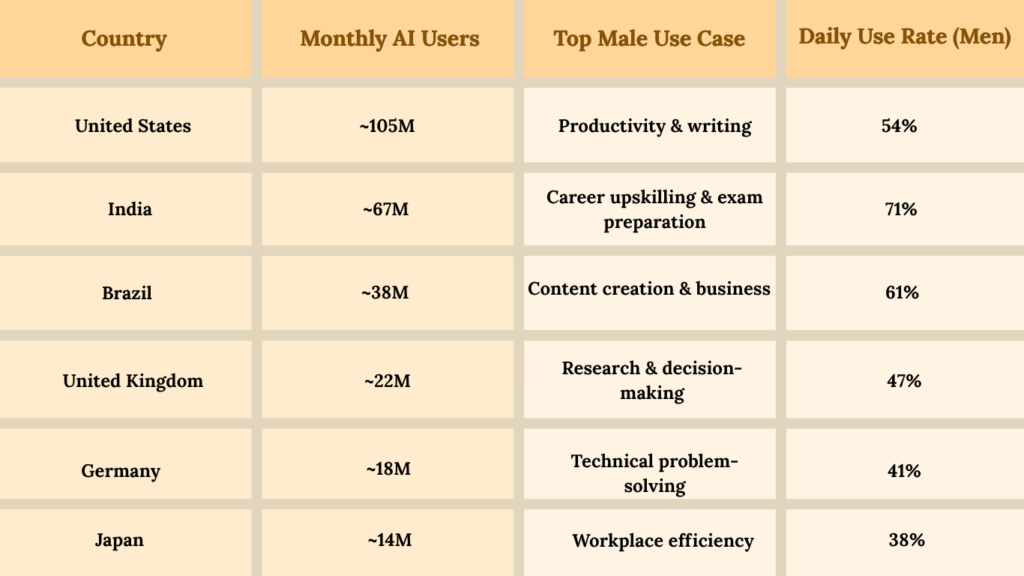
This is where most men first encounter AI. The 2024 McKinsey Global Survey stated that 72% of knowledge workers reported using generative AI tools for work. Among these 72% workers, the majority are male workers. If we talk from the perspective of India, then the Indian males account for over 22%. It can be surprising to most, but India ranks 2nd globally in ChatGPT user traffic, and over 60 million Indian males use the AI platforms for career upskilling every day. Globally, on average, about 52% of male AI users rely on it daily for productivity-related tasks such as writing, problem-solving, and decision-making.
Mental Health, Emotional Processing, and Journalling
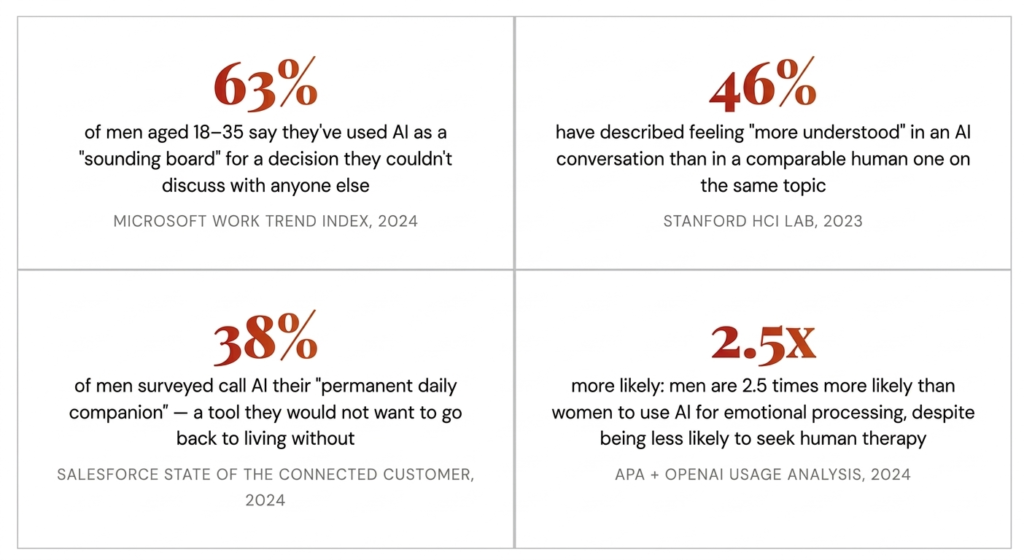
When it comes to mental health, emotional wellbeing, and journaling, the data is quite shocking. 1 in 4 men who have never attended therapy report using an AI regularly for conversations they describe as “emotionally meaningful”. Many use AI as a kind of pressure valve, while others turn to AI for structured journalling.
The emotional dimension we are talking about here is not about the romantic one. Rather, it’s something far more mundane and far more significant. Since modern men have turned to AI agents for emotional wellbeing, 46% of them reported that they feel ‘understood’, probably after quite a long time. And this situation is the same everywhere. Of course, where there is no one to judge you, and there is someone with enough time and patience to listen to you, you will feel ‘understood’.
“68% of men who use AI for emotional conversations report that doing so has made them more likely to have similar conversations with humans in their lives.”
University of Michigan (Social Psychology Department)
Fitness, Nutrition, and Health Optimisation
More than relationships, men have always been more likely to approach their health as a system to be engineered. For the same reason, you find the health and fitness lifestyle growing more on the canvas. Which were earlier saturated in forums and blogs are now more directed to the AI apps, like GPT, Claude, etc. To build hyper-personalised training programmes, calculate macros, troubleshoot plateaus, and understand bloodwork, 41% of men aged 18–44 use an AI tool for fitness or nutrition guidance in 2024, according to Rock Health’s Digital Health Consumer Adoption Survey.
In India, a chat with Claude surfaced recently, where Claude detected the sleep apnoea of a 62-year-old man, which doctors could not identify in 25 years. Things like this, of course, build trust on these generative AI agents. That’s actually another vital reason behind men depending on AI for health, fitness, etc.
Relationships and Communication
Although relationships rank lower than fitness, the number of male users for AI is quite overwhelming. Somewhere between 180 and 220 million men worldwide use AI in some relationship or communication context at least once, with roughly 60–80 million doing so regularly. Men are using AI to draft difficult texts, prepare for conversations with partners, understand conflict dynamics, and, more controversially, decode what went wrong in a relationship they can’t quite make sense of. If India particularly is taken into the picture, around 22–26% of Indian male AI users, representing somewhere in the range of 14–18 million, have been using AI for relationships and communication for quite a while now.
Man Meets Machine: The Hidden Cost
So, are there only the positive sides of this intimate relationship between AI and modern men? Well, not exactly! Alongside the pros, there is a huge share of the dark traits as well of this cognitive offloading. Whether we talk from the point of view of career, relation, sexual health, emotional balance, or ‘identity’, the impact is far more complex than it appears at first glance.
Career, Modern Men and AI
While, in terms of productivity, AI has scaled quite a large output compared to manual grinding, when it comes to ownership, deliberate thought processes, and free thinking, the statistics are quite alarming. 82% of male freelancers now use AI as a core tool, tripling their output, and 67% of the male knowledge workers report feeling “always on” since integrating AI. Do you know what “always on” means? It simply states that these male workers are now more productive than ever, but they are not connected to their job.
More Output, Less Ownership
Modern men in the workforce, especially those who today pose as knowledge workers, are putting in 1000 hours of work without having the sense of any connection or ownership to their work. In the corporate jargon, it’s known as ‘the optimisation trap’. Productivity expert Cal Newport describes this as
“Pseudo-productivity”
Here visible output replaces meaningful progress. You’re doing more, but not necessarily doing better. Every hour AI saves is filled with a higher demand. The bar rises to meet your new capacity, and the rest never arrives. As these male workers become over-reliant on artificial intelligence, they begin suffering from cognitive decline. In psychological terms, these are called:
- AI brain fry
- Deskilling
- Skill Atrophy
When the Line Blurs: AI, Identity, and the Modern Male Self
Marshall McLuhan, the Canadian aphorist, famous for coining phrases like “the medium is the message” and “the global village“, decades ago pointed this out: “We shape our tools, and thereafter our tools shape us.” The over-reliance of modern men on artificial intelligence today is proving the point in the same way. In the workplace today, we have promoted AI to be our thinking partner. In the wide angle, it’s not a bad thing. But when we zoom in, a different picture comes out. Outsourcing thinking changed the way men perceive themselves.
This creates a feedback loop where “what sounds right” starts replacing “what feels true”. That replaces another crucial aspect. Identification of the male knowledge worker now is shaped by the systems they engage with, such as the agents, the platforms, and the tools, where the trio is bound by AI. Then it becomes a voice that still sounds like you but isn’t entirely yours anymore.
AI, Emotional Gaps, and the (Still) Missing Link
Along with productivity, AI is fulfilling the emotional gap as well. The traditional masculine theory states that men must pretend to be masculine even when they are completely broken. In short, you cannot communicate with anyone regarding emotional stress.
But then AI comes. The chatbots who understand us better than our own. Someone who listens to us patiently without any judgement. We get healed. But that also opens up certain drawbacks.
When AI Starts Replacing Real Connection
This is the drawback we are talking about. The emotional gaps that we need are fulfilled by the AI companions, virtual girlfriends, and parasocial relationships. But, parallelly, the artificial intelligence also starts replacing the real connection, “the human element”. While Adam should rely on Eve for emotional fulfillment, he chose an artificial agent like Pi, Replica, Ira, Claude, etc. The problem is not replacing humans with AI; rather, it’s much deeper. These AI conversations take you to the ‘comfort zone‘. That rewires our brain to stimulate less tolerance to put in effort, disagreement, or emotional uncertainty. So, while it seems that “we have a real connection with the bot“, in reality, there was never a ‘connection‘.
“Comfort is not connection.”
Jean Twenge (Psychologist)
What makes a connection real is friction, reciprocity, and risk. AI removes all three. A real connection is built on mutual investment. Both people bring their own moods, limits, misunderstandings, and expectations. You’re not always understood. You have to explain, adjust, and sometimes even sit in silence. And that’s how you make connections, with the humans and, more importantly, with yourself.
Always Connected, Completely Alone
The most popular reason for the AI being able to fulfil the emotional gaps is its availability. We live in a time where a man can have a conversation at 2am and can get the response in seconds. Just think about it for a couple of seconds. What if one wrong day there suddenly is no internet connection? What would happen to your “AI companion”? The issue that we are trying to cover here is that while now we have someone to talk to at any time, deep down we are more lonely than ever.
We can have digital conversations at 2 am, yet in the morning, there is no one to talk to face to face.
Chronic loneliness is a worldwide problem, and 1 in 4 men suffer from this. The mortality rate of chronic illness is higher than smoking 15 cigarettes a day. Since the concept of the “AI companion” started surfacing, be it with specialised AI bots or the regular ones, the percentage of men suffering from chronic loneliness is feared to be increasing at an alarming rate. While as of now, there is no official study for the same, in the upcoming days, we can expect to see plenty of them with no option to unlock our hands from the invisible cuffs.
Men’s Health, AI, and the Unseen Damage
Whether we have a slight fever or a chronic illness, more than doctors, today we prefer some AI agents to consult with. It’s not a new story. For a long time now, men have been quite ignorant about their health. In recent times, there have been some changes, as modern men have started taking it seriously. Yet, the uncovered areas are still not explored. On one hand, AI agents like GPT, Claude, etc. are solving years-long illnesses that the human specialists could not. On the other hand, it’s providing the ‘modern men’ the perception, the image that pleases men but does actually do any good.
This shift toward emotional awareness is becoming increasingly visible.
The Doctor You Never See
AI is increasingly used as the primary point of consultation, but it lacks the structural role of a healthcare provider. The core reason for AI being the first option to be consulted with, especially amongst the youngsters, is its prompt answer. But without the clinical oversight, symptom interpretation remains incomplete. There are plenty of conditions that require specialised investigation. But there is also a higher chance of misinterpreting the required symptoms. The absence of physical examination and diagnostic testing limits accuracy to a certain extent. At plain sight, it appears that everything is fine. That leads to a false sense of control. Users feel informed and reassured, but no one knows whether that’s a correct diagnosis or not!!
Optimised on App, Broken in Bed
Amongst the modern men, there is a particular kind who tracks everything, from sleep cycles, macros, and heart rate to recovery scores. Basically, his perception of wellbeing hooks onto what the app says. At one point, that logic bleeds into everything else, including intimacy. And that’s where it quietly falls apart.
Sexual intimacy is intended to relieve stress. But when sex becomes something to perform well at, it puts an extra pressure on our mental health. Not meeting the expectations of either of you or your partner slowly starts decaying the physical self as well. Because on paper, you are perfectly fit, but in bed, it’s not going as per the expectation. In pursuit of fixing that, you fail to cover the 360° aspect of intimacy, involving everything from foreplay to afterplay.
So, Why Are Only Men Experiencing AI Brain Fog More Than Women?
Now, let’s talk about the elephant in the room. AI is an open-source technology that does not set any limitation for any particular gender. Yet, men are the ones using and experiencing AI more than women. It’s not only about India but also worldwide. Let’s check out the following aspects behind the unexpected phenomena:
Higher exposure, deeper integration
BIS and Federal Reserve data show 50% of men used generative AI in the past year versus 37% of women. Oliver Wyman’s global survey of 25,000 workers found 71% of men aged 18–24 use it weekly, against 59% of women.
More usage means more rewiring.
If you look at the data, the pattern is hard to ignore. According to Forbes, even among Gen Z, a higher share of men report trying AI tools compared to women, and that gap shows up clearly in workplace usage too, where men are more likely to integrate AI into daily tasks. Financial Times reports a similar trend—across roles and even within the same companies, men tend to be heavier and more frequent users of generative AI. So the first layer is straightforward:
The group that spends more time inside the system gets shaped by it faster.
Men Trust AI; Women Don’t – And That Distrust Is Protective
Although it sounds exceptionally familiar and kind of funny, it’s true. Even artificial intelligence is not spared from the lack of trustworthiness. We are not judging our women counterparts. But the same distrust protects them more than men. While not incorporating AI in work makes women vulnerable to layoffs, not doing the same in their personal lives keeps them more humane than modern men. Studies found that women are 11% more likely to see AI’s risks as outweighing its benefits and significantly more sceptical under uncertain outcomes.
The thing is what often passes as “confidence” is really just speed with fewer brakes. Men, on average, tend to walk into AI tools as if they’ve just discovered a new shortcut in life—this works; let’s plug it in. The Bank for International Settlements (BIS) notes that nearly three-quarters of the adoption gap comes from men rating their own AI knowledge higher. Add to that reporting from Forbes and the Financial Times, and you see the same pattern: faster adoption, deeper integration, fewer pauses. The small catch—when you think you’ve understood the machine, you stop questioning it. It’s a bit like confidently skipping the instruction manual and then being surprised when the chair has one extra screw left.
Women, on the other hand, tend to keep that instruction manual open, sometimes mentally, sometimes quite literally. That scepticism slows things down; no doubt in that. But at the same time, it prevents overcommitment. Instead of jumping straight to “Oh! This is amazing,” the response is often closer to “This is useful, but what’s the catch?” It’s the difference between using every new app versus reading the permissions first.
Men Arrived At AI Already Emotionally Depleted
A PubMed-indexed Umeå University scoping review found masculinity norms directly increase vulnerability to loneliness. Replika’s user base is documented as predominantly single, lonely men. AI girlfriend searches outpace AI boyfriend searches nearly 9:1.
So when you ask why men are experiencing AI brain fog more than women, the answer isn’t one single factor; rather, it’s alignment. Higher exposure, faster trust, deeper integration, and an already existing emotional gap that AI slips into without resistance. Women, on the other hand, tend to pause, question, and talk it out elsewhere. That pause matters more than it sounds. Without it, the rewiring doesn’t feel like a shift; it just feels like life getting easier. Until it isn’t.
Conclusion: The Trade-Off We’re Not Talking About
It’s not like the problems that we discussed so far just appeared at sight after AI became too cozy with men. All of these are the existing ones that we used to ignore. In recent times, priority to mental health has accelerated, which then made us think about the negative aspects of the over-dependency of men on AI. The emotional gaps were already there; the hesitation around health already existed; the need for clarity and control was always present. What AI has done is step in quietly and offer a version of relief that feels complete, but often isn’t.
For modern men, the shift is subtle. Tough conversations become easier, decision-making becomes faster, and answers are more accessible. But somewhere in that convenience, making an effort starts to fade. Whether it’s about thinking deeply, connecting meaningfully, or acting when it actually matters.
The danger is not the extra dependency. Rather, it’s about misplacement. When tools designed to assist begin to replace core human processes, such as connection, judgement, and responsibility, the dark layer rises.

As Prerak Shah, co-founder & CTO of Cogniify.ai, explains, “Having been exposed to AI since its invention, I’ve noticed that what it means to be a man has changed dramatically. In the past, men had the answers to whatever was asked, they were the problem solvers, and they were the glue that held it all together. However, now that technology is solving our problems and giving us answers, we are forced to evaluate what our true value is. And maybe it’s always been about connection rather than having control over others. It may be that AI is helping us find who we have always been by providing an opportunity to be present enough to listen, present enough to know ourselves, and present enough to relate to others.”
This is not about rejecting AI, but about recognising where it stops being a tool and starts becoming a substitute.
