Inside the vision, journey, and breakthroughs shaping the future of intelligent systems — a conversation with the founders of Cogniify AI.
Artificial intelligence has entered a strange phase in modern business. Companies are investing aggressively, pilots are multiplying rapidly, and “AI transformation” has become a boardroom priority across industries. Yet beneath the excitement lies a quieter reality: many systems never move beyond experimentation. Promising demos fail inside fragmented organisations, automation struggles against human complexity, and businesses discover that intelligence at scale is less about algorithms and more about trust, structure, and decision-making itself.
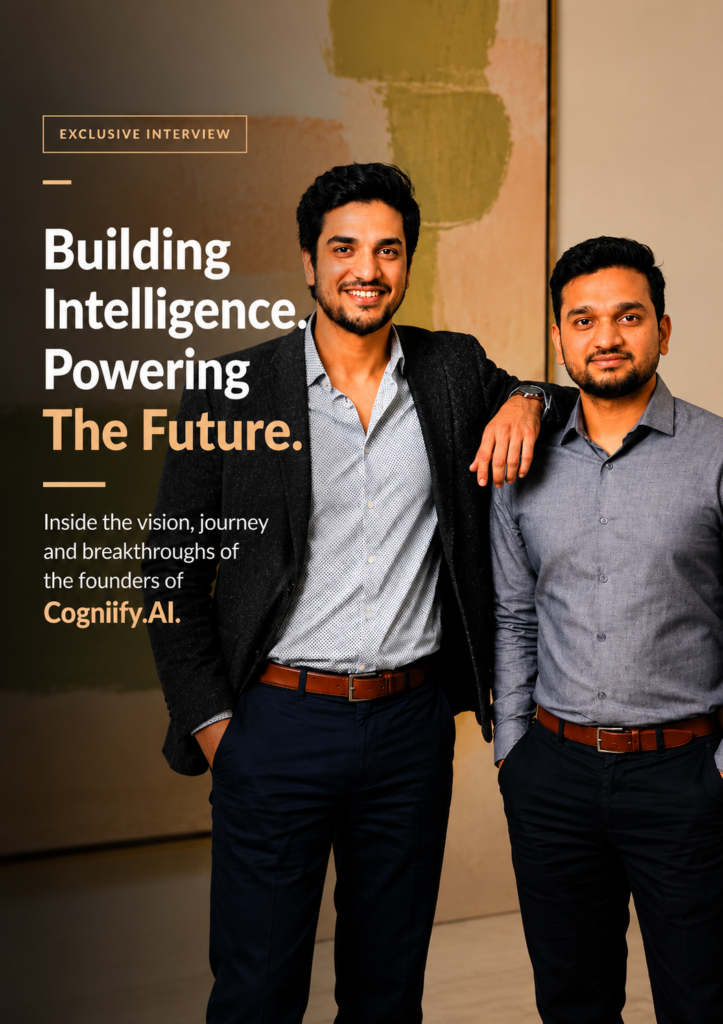
For Cogniify.ai founders Aksheshkumar Ajaykumar Shah and Prerak Manish Shah, this gap between innovation and implementation defines the real challenge of modern AI.
In this conversation with BestForHim, the duo explores where enterprise systems break, why organisations misread AI adoption, how digital twins diverge from reality, and why human judgement remains central even as intelligent systems become more autonomous.
The discussion moves beyond technology alone — into the architecture of modern organisations, the psychology of reliance, and the future of intelligence-driven business.
A recent study found that banking systems have been running in AI pilot mode for the last three years, which has gone nowhere. It’s named ‘death by a thousand POCs’. They have great demos, but no real deployment. Where do you see most systems breaking when they try to cross that line into production?
A lot of times, banking AI initiatives do not result because of bad technical innovation; they fail due to the organisation’s failure to realise just how complex it is going to be to grow this innovation into their existing technology.
Most often what causes failure within organisations is the lack of integration of fragmented data, the lack of respect for regulatory constraints, insufficient knowledge of who has ownership of various aspects, and/or a lack of readiness for new and/or changed processes associated with rolling out a new product.
Most successful pilots are in a controlled environment, whereas production environments require a high degree of trust, visibility, governance, integration and measurable results. Without aligning your AI initiatives to your organisation’s core strategy, with process transformation, or with stakeholder buy-in, the proof-of-concept will continue to exist in isolation.
Moving from proof-of-concept to production requires shifting your organisation’s view of AI from being a technology demonstration to being an enterprise-wide business capability with inherent resilience and compliance.
The real challenge is not building AI models — it’s integrating intelligence into how organisations actually operate. AI at scale requires alignment between systems, decision-making, and business culture. Without that integration, even the most impressive experiments never realise their true potential.
Aksheshkumar Ajaykumar Shah
When you walk into an organisation, what typically turns out to be the real bottleneck—data quality, workflow design, or the way teams are making decisions? And how often is the AI itself actually the problem?
Aksheshkumar Ajaykumar Shah: In many organisations, the limiting factor is rarely the technology itself, but rather fragmentation of decisions, siloed processes, and ambiguity in strategic alignment. While poor quality and ineffective workflow certainly have an impact; businesses are usually unsuccessful due to a lack of structure for translating information into actionable confidence. AI is typically not the cause of these issues but rather is indicative of deeper operational gaps. Success will come from building solid foundations of data, processes and people working together before expecting AI to drive significant transformation.
Most organisational challenges don’t start with AI but with unclear decisions, fragmented workflows, and misaligned systems. Real transformation comes from rethinking operations, not just adopting new technology.
Prerak Manish Shah
A lot of businesses want to “use AI” without a clear use case. How do you separate real problems from forced adoption, especially when expectations are already inflated?
Prerak Manish Shah: Most organisations see AI as a fad rather than a tool for strategy, which has caused varying levels of return for the investments placed into AI by many organisations. Cogniify starts with identifying the core business issue that we are solving for an organisation first, and only then do we recommend any technology (AI included) to solve that issue. We always approach our first goal to solve significant problems, increase efficiencies and unlock measurable value, and never simply use AI for cosmetic purposes. We help businesses understand the difference between hype and effect by aligning their AI adoption with clear business outcomes, operational readiness and long-term viability. Real transformation is accomplished when AI is applied in a purposeful manner to real business problems with high precision and is not forced into systems where it will generate little to no value.
Many organisations treat AI as a trend instead of a strategic business capability, leading to investments that generate more hype than value. The real priority is not deploying technology for its own sake but solving meaningful business problems with measurable outcomes. True transformation happens when AI is aligned with scalability, long-term impact, and real operational needs.
Aksheshkumar Ajaykumar Shah
Where do you see yourselves in the stack—are you improving workflows or starting to influence how decisions get made?
Aksheshkumar Ajaykumar Shah: By leveraging all three of these components, we are equipping companies to transition from just being optimised operationally to making intelligent decisions. The focus is on embedding data-based clarity into how leaders think about leading by allowing them to see change in advance, identify opportunities and make more definitive, timely, and impactful business decisions.
At Cogniify, we see our evolution as transforming organisations beyond just optimising workflows by enabling smarter, faster, and more confident decision-making through intelligence-driven, predictive ecosystems.
Prerak Manish Shah
You’ve spoken about structuring intelligence through layers like signal, system, scale, and sustainability. In practice, where do most companies break first—and what does it take to move from scattered signals to something that behaves like a system?
Aksheshkumar Ajaykumar Shah: The primary reason organisations do not succeed is not due to the absence of data; it’s the way the data is treated that turns into the main reason that organisations do not operate effectively. It can often be the very first disconnection of availability of insight for effective use when the data isn’t connected across operationally integrated systems. Creating a true system from disparate sources requires an alignment of all data, technology and decision-making to create a single aligned framework.
Companies fail not because of a lack of data, but because they fail to properly define, align, and connect that data into a cohesive, intelligence-driven system tied to business objectives.
Once that system is in place, scaling it without breaking trust becomes harder. Where do teams usually compromise speed, accuracy, or long-term sustainability?
Aksheshkumar Ajaykumar Shah: When organisations scale their AI systems, the real challenge is preserving trust as they create more impact from their AI systems. Many teams try to go too fast in deploying their AI models without adequately considering issues such as proper governance practices, model transparency, and data quality and instead focus only on getting the fastest results possible. As a result, such systems are often fragile and perform quickly but do not have enough resilience. The true measure of a company’s ability to scale is due to the creation of efficient and intelligent frameworks that continue to evolve and are reliable, flexible and accountable throughout their lifetime.
Prerak Manish Shah: Scaling too rapidly can cause teams to fall short of establishing a solid foundation of trust prior to developing their teams; speed will outpace governance and data quality and ethical oversight, and inaccurate models may not be properly maintained or fragmented within the context of operational processes. Achieving true scale means achieving a balance between innovation and discipline to ensure AI responsibly evolves, remains reliable, and produces benefits without compromising future accountable delivery.
You’ve already implemented digital twins in real environments. When these systems start interacting with live business processes, where do they diverge from reality the most? And is the harder problem maintaining model fidelity or getting teams to trust outputs that don’t come from a human chain of reasoning?
Aksheshkumar Ajaykumar Shah: Digital twins diverge from their physical twin at the edges of unexpected human activity, incomplete data loops and changes in the market. For example, an optimised supply chain digital twin may be able to optimise inventory, but it may not account for real-world disruptions due to vendor delays. In our experience, the more difficult problem is not with the accuracy of the model but instead with building trust in the organisation. Teams are used to making decisions based on human judgement, so we use explainability, scenario testing and gradual adoption to help teams to feel like they made the best decision when using the system and using intuitive reasoning.
Prerak Manish Shah: Digital twins are very powerful; however, one of the greatest reasons why digital twins differ from the real world is because of human unpredictability, changing operational nuances and inaccurate up-to-the-minute data. Technology is able to replicate systems with incredible accuracy, but a business is a living ecosystem influenced by behaviours, culture and external disruptions. In addition to having a technical challenge in building and maintaining models with high fidelity, there is also more difficulty for teams to have faith that the insights produced by artificial intelligence are explainable, trustworthy and in line with their strategic judgement before they fully adopt AI-led decision-making.
When a digital twin is wrong, how quickly does the organisation typically realise it—and what does that delay actually cost in real terms?
Prerak Manish Shah: Organisations typically don’t know that their digital twin is incorrect until they see operational inefficiencies, financial losses, or service delivery disruptions; this could take several weeks or months to become evident. The actual cost of a digital twin not being correctly validated and kept in sync with a real-time system is actually more than just losing revenue; it also includes lost trust and agility. The value is not only in developing digital twins but also in validating, updating, and aligning them over time with the changes that occur in the real world.
The full value of AI is achieved when it enhances rather than diminishing human ability. The risk arises when businesses replaces critical thinking and decision-making processes with automation. Preventing over-reliance on AI requires proper oversight, accountability, and continuous human validation.”
Aksheshkumar Ajaykumar Shah
As AI systems start assisting with decisions, accountability becomes less clear. What do you think about responsibility when a machine is part of the decision-making process?
Aksheshkumar Ajaykumar Shah: Humans will always be responsible for decisions made using AI machines that are incapable of ethical or contextual judgement; they can provide insights through pattern recognition, create forecasts for future events, and simplify sophisticated analyses. For good government to exist, governance must be provided with transparency; oversight by humans, explainable AI and ethical responsibility must be provided in every aspect of the process.
Prerak Manish Shah: Humans must be responsible when making decisions with AI. Although AI can identify patterns, anticipate, and generate better outcomes, it cannot take accountability and transfer it to a computer, irrespective of the amount of data that is used or whether an algorithm is created to provide predictions. At Cogniify, we believe that AI is a tool, not a decision-maker. Ultimately, the leaders and organisations that use AI and technology are responsible for ensuring transparency and ethical use of their AI systems as well as exercising good judgement regarding their use. AI should function as a source of increased trust between humans and technology when there is clarity, control, and confidence associated with its operation.
Deploying AI at scale can be expensive—sometimes even outweighing the short-term revenue upside. When working with clients, how do you decide where to invest aggressively and where to stay lean? And internally, how do you balance building systems that are robust enough to last while keeping them efficient enough to justify the investment?
Aksheshkumar Ajaykumar Shah: We choose to focus our efforts on high-impact use cases where strong measurable returns support larger-scale investment than lower-impact use cases. For lower-impact use cases, we apply lean models and phased rollout. Internally, we will be building modular, flexible solutions so that we can grow them over time while incurring minimum rebuild costs. We believe that building sustainable AI solutions incorporates the concept of balancing ambition against precision when developing usable solutions for today while being sufficiently robust to handle ongoing changes into the future.
At Cogniify, we invest aggressively in AI initiatives that deliver long-term strategic value while building robust yet modular systems that balance future readiness with operational efficiency.
Prerak Manish Shah
In the recent AI Rewiring Modern Men article, Mr Aksheshkumar mentioned that AI is shifting value from “having answers” to being more aware of how we think and relate to others. In the systems you’re building—where AI actively supports decisions—do you see people actually becoming more aware, or simply more reliant?
In AI Rewiring Modern Men, the founders of Cogniify.ai spoke about how AI is slowly reshaping not just workflows but also human effort, judgement, and decision-making behaviour. They highlighted the growing risk of organisations becoming overly dependent on automation without preserving critical thinking and human accountability. Expanding on that idea, Aksheshkumar Ajaykumar Shah explains where AI can begin replacing judgement instead of supporting it — and why maintaining human oversight remains essential.
Aksheshkumar Ajaykumar Shah: The true benefit of AI for leaders comes from using AI to detect hidden assumptions, identify blind spots in their judgement and help them make better, more qualified decisions. An example of this would be using predictive analytics to guide supply chain management; however, trust from customers is ultimately based on empathy, which will always be a characteristic of human interaction. AI should be viewed as a tool that enables human beings to think about problems in a more profound way, which leads to increased critical thinking, collaboration, and strategic foresight, rather than a means of developing unquestioned allegiance.
AI is most powerful when it enhances human intelligence, not replaces it. The risk begins when businesses let automated systems override human judgement, critical thinking, and decision-making. True transformation happens when AI strengthens uniquely human abilities.
Prerak Manish Shah
