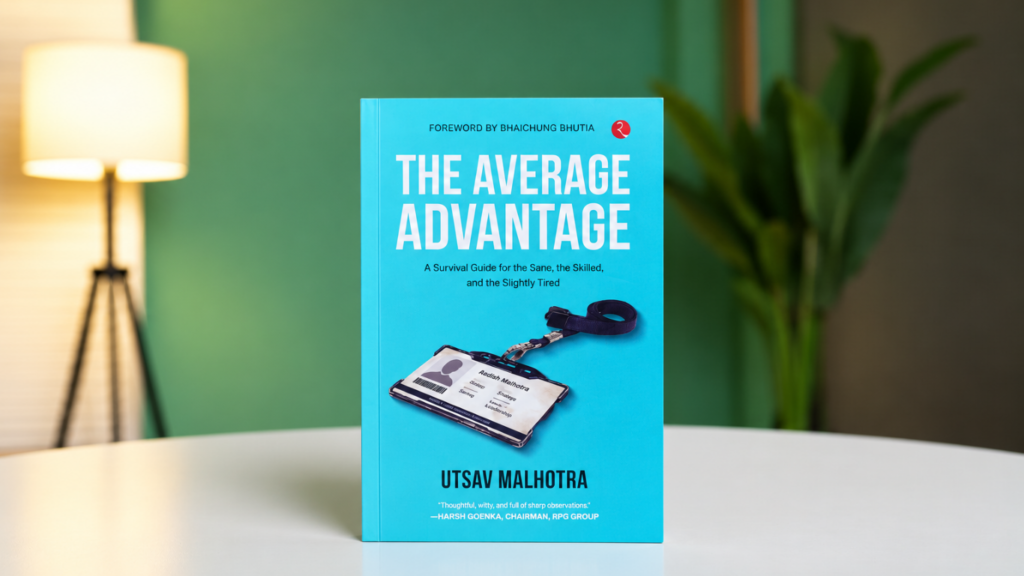
In a world that constantly tells men to do more, earn more, achieve more and become more, Utsav Malhotra’s debut book offers a rather uncomfortable question: what if an ordinary life is not something we need to fix?
There is a particular kind of exhaustion that comes from feeling like you are never doing enough. You could have a decent job, a reasonably comfortable life, people who care about you and a career that is moving in the right direction, yet somehow, you still feel behind. Someone your age has bought a house, someone else has started a business, another has been promoted, and someone you went to college with is posting pictures from yet another international holiday. Suddenly, your own life starts looking like a series of things you haven’t quite achieved.
For men especially, this pressure can be difficult to escape. Success has long been tied to professional achievement, financial independence, status and the ability to provide. Somewhere along the way, simply doing well stopped being enough. You were expected to be exceptional at your job, physically fit, financially secure, socially interesting, emotionally intelligent and constantly working towards the next big thing.
And if you were not doing all of that, you were probably not trying hard enough.
It is this exhausting idea of success that Utsav Malhotra challenges in his debut book, The Average Advantage: A Survival Guide for the Sane, the Skilled, and the Slightly Tired. Published by Rupa Publications, the book questions our obsession with extraordinary achievement and makes a case for something considerably less glamorous: being consistently good at what you do.
The problem with wanting to be extraordinary
The word ‘average’ rarely receives a compliment. In school, it meant you could do better. At work, it suggested you were not particularly ambitious. In conversations about success, it was usually the category people were desperately trying to escape.
Malhotra wants to reconsider that understanding.
Drawing on more than two decades of experience in Indian corporate life, he looks at the expectations that have gradually become attached to modern careers. Follow your passion. Build your personal brand. Network constantly. Climb the corporate ladder. Never stop hustling. Even your weekends should ideally contribute to some larger professional goal.
The problem is not necessarily that these ideas are bad. It is that they have become expectations rather than choices. Somewhere between trying to build a career and trying to build a life, the two have become almost impossible to separate.
Malhotra makes an important distinction between being average and being mediocre. The former is simply a reality of being human; nobody is exceptional at everything. Mediocrity, on the other hand, is about a lack of effort. You can be an ordinary person who takes pride in his work, develops his skills and builds meaningful relationships. There is nothing particularly mediocre about that.
It is a refreshing argument, particularly when so much of modern professional culture makes people feel that their everyday lives are inadequate.
The hustle culture trap
One of the more interesting aspects of the book is its willingness to question advice that has practically become gospel in the professional world.
Take the idea of following your passion. It sounds wonderful, of course. We have heard it from successful entrepreneurs, motivational speakers and just about every career coach on the internet. But what happens when you don’t know what your passion is? Or when the thing you love doing does not pay your bills?
Malhotra offers a different way of looking at it. Rather than waiting for passion to reveal itself, he suggests that competence and skill can create passion over time. The more capable you become at something, the more rewarding it can feel.
It is a small but meaningful shift in perspective. Not everyone needs to discover a grand calling before beginning a career. Sometimes, you simply start somewhere, learn your craft, become good at it and find satisfaction along the way.
The book also takes aim at the personal branding culture that has made professional life increasingly performative. Today, it is not always enough to do your job well. You must also make sure everyone knows you are doing it well. Every achievement becomes content, every professional interaction an opportunity to network, and every career milestone something to announce.
There is certainly value in making your work visible. But there is a difference between building a reputation and constantly advertising yourself. One is earned through competence and trust; the other can become an exhausting exercise in keeping up appearances.
Malhotra’s argument is not that ambition is unnecessary. It is that ambition should not turn your entire existence into a performance.
Your career is not your entire life

Perhaps the most relatable part of this conversation is its treatment of burnout.
For years, working long hours has been treated as evidence of dedication. Being unavailable after office hours can feel like a professional disadvantage, and taking a break sometimes comes with an uncomfortable sense of guilt. Men, in particular, may find it difficult to admit that work is taking a toll on them, especially when they feel responsible for providing financial stability or maintaining a certain standard of living.
But there is a difference between working hard towards something and allowing work to consume everything else.
Malhotra examines the less glamorous realities of corporate life, including office politics, middle management, workplace hierarchies, meetings and performance evaluations. These are not necessarily the subjects that make for exciting motivational speeches, but they are the things that shape most people’s working lives.
His perspective is particularly relevant to those who occupy the middle of an organisation. They are often expected to deliver results, manage people, satisfy senior leadership and keep things running, without necessarily receiving the recognition that comes with being at the top.
It is an experience many professionals will recognise. You may not be the person presenting the big ideas in the boardroom, but you are often the one making sure those ideas actually get implemented.
And there is value in that.
The quiet power of consistency
Perhaps the most compelling idea behind The Average Advantage is that meaningful success is rarely built through a handful of extraordinary moments. It is built through ordinary actions repeated over a long period.
Think about the things that genuinely improve a man’s life. Becoming better at his profession, looking after his health, maintaining friendships, developing financial discipline, being present with his family and learning to make better decisions. None of these necessarily produces an overnight transformation. Most of them are rather unremarkable on a day-to-day basis.
But over five, ten or twenty years, they can make an enormous difference.
This is the idea of compounding that runs through Malhotra’s argument. It is not just money that compounds. Skills, judgment, relationships, professional credibility and even health can accumulate through consistent effort.
It also changes the way we look at career growth. Instead of constantly asking whether we are progressing fast enough, perhaps we should ask whether we are becoming better at the things that matter. A promotion or a salary increase may be an important milestone, but the ability to do meaningful work without sacrificing your health or relationships is equally worth considering.
The distinction matters because careers are long. A person who can sustain a reasonable pace, keep learning and remain useful over decades may ultimately build something far more meaningful than someone who burns brightly for a few years and runs out of steam.
An antidote to the comparison game
There is another reason why the book feels relevant today. We are living in an age where other people’s achievements are constantly on display. Social media has made it remarkably easy to compare our everyday existence with someone else’s carefully selected highlights.
You see the promotion, not the uncertainty that came before it. You see the expensive holiday, not necessarily the financial decisions behind it. You see the successful entrepreneur, not the years of mistakes and difficult choices.
Over time, it becomes easy to mistake visibility for success.
The Average Advantage encourages readers to reconsider whose definition of success they are actually following. Perhaps the life you want does not need to look particularly impressive to everyone else. Perhaps a stable career, good health, financial security, meaningful relationships and enough time to enjoy your life are perfectly reasonable things to aspire to.
That does not mean giving up on bigger dreams. It means recognising that you do not have to turn every day into a demonstration of your potential.
Is being average really an advantage?
What makes Malhotra’s book interesting is that it does not ask readers to abandon ambition or settle for less. Instead, it questions the pressure to make every aspect of life extraordinary.
There is something reassuring about that proposition. Not every man is going to become a founder, a CEO, a millionaire or a public figure. Nor does everyone need to. Most people are building their lives quietly, balancing responsibilities, figuring things out and trying to make the next year a little better than the previous one.
And perhaps that is a perfectly respectable way to live.
The Average Advantage is particularly worth considering for young professionals entering an increasingly competitive workplace, as well as those who have spent enough years climbing the corporate ladder to wonder whether they are enjoying the view. It offers a grounded perspective on ambition, professional growth and the importance of knowing when enough is enough.
If there is one thought worth carrying away from the book, it is that an extraordinary life does not necessarily require extraordinary days. Sometimes, it simply requires showing up, doing the work, taking care of yourself and staying consistent for long enough.
After all, there is more to being a successful man than having an impressive answer when someone asks what you do for a living.
