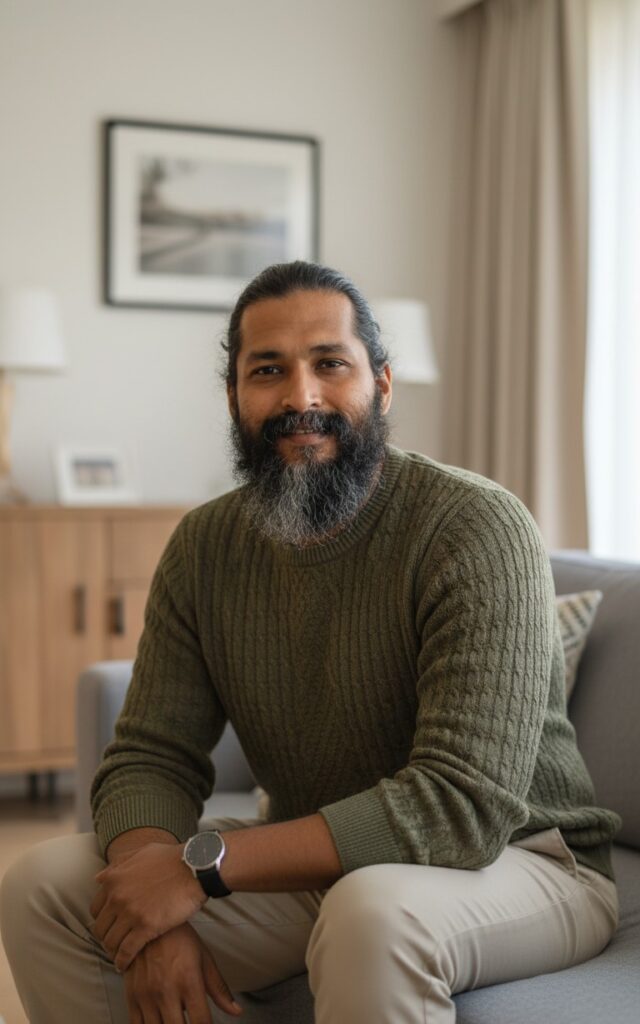
There is a particular kind of silence I have come to recognise over the years across boardrooms in Mumbai, Delhi, Bangalore, Dubai, Riyadh, Doha, Singapore, Hong Kong, Jakarta, and beyond. It is not the silence of ignorance, nor of disengagement. Quite the opposite. It is the silence of men who know a great deal, who have carried responsibility for decades, who have built careers brick by brick and yet, increasingly, say less about what truly matters.
These are men in their forties and fifties. Senior vice presidents, founders, country heads, functional leaders. By most external measures, they are successful. They have endured volatility, navigated internal politics, sustained families, and often financed the aspirations of entire extended ecosystems around them. And yet, if you sit with them long enough, not in the formal cadence of a meeting but in the unstructured quiet of a late evening, you begin to notice something deeper: a narrowing of expression. A preference for facts over feelings. Decisions over doubts. Outcomes over inner states.
This silence is not accidental. It is inherited, reinforced, and perhaps most importantly, rewarded. But it comes at a cost that is no longer invisible.
The Long Shadow of Evolution
To understand this pattern, we must step outside the modern corporation. In early human societies, survival required emotional economy. Men were often tasked with hunting, defending, and navigating external threats. These roles favoured composure under pressure, emotional restraint, and decisive action. Vulnerability, particularly in moments of risk, could compromise not just the individual but the group. Over generations, these traits, stoicism, control, suppression of fear, became embedded as markers of masculinity.
The modern executive, in many ways, is a continuation of that archetype. Today’s corporate leader is still expected to remain calm in crisis, decisive in ambiguity, and composed under scrutiny. Emotional transparency, especially around uncertainty or personal strain, remains subtly penalised. A global leadership perception study by McKinsey found that over 70% of senior executives believe that openly displaying vulnerability could weaken how their leadership is perceived. The signal is clear, even if unspoken: control is credibility.
The Cultural Weight of Silence in Asia
In Asia, this evolutionary inheritance is amplified by culture. Across much of the region, men are expected to be the stable centre, the financial anchor, the emotional constant, the one who absorbs pressure without transmitting it. The idea of losing face extends beyond personal embarrassment; it reflects on family, hierarchy, and social order. Collectivist systems reward restraint. Harmony is prioritised over confrontation. Respect is often expressed through measured speech or silence.
From an early age, many men internalise a simple rule: you carry the burden, you do not verbalise it. By the time they reach their forties, this is no longer a belief. It is instinct.
The Corporate Amplifier
If culture sets the baseline, the corporate environment intensifies it. The metro-Asian executive operates in a state of continuous demand: cross-border calls, compressed timelines, performance metrics that rarely pause. The boundary between professional and personal life has not just blurred; it has dissolved.
According to Deloitte’s 2024 Global Human Capital Trends report, nearly 6 in 10 mid-to-senior professionals in Asia report chronic fatigue or symptoms of burnout, even while continuing to perform at expected levels. This is not collapse. It is sustained depletion.
More telling is what does not happen. Instead of visible disengagement, what emerges is a quiet opt-out: capable leaders declining larger roles, reduced participation in strategic discussions, increased compliance with reduced challenge, and a subtle retreat into execution over influence.
Gallup’s workplace research adds another layer: only 23% of employees globally report feeling truly engaged at work, with engagement levels among mid-career managers declining after the age of 40. Among men in hierarchical cultures, disengagement often expresses itself not through exit but through silence.
This is not apathy. It is an adaptation.
The Hidden Cost: Burnout, Isolation, and Physical Strain
Silence, when sustained, does not remain neutral. It accumulates pressure.
The World Health Organisation defines burnout through three dimensions: exhaustion, cynicism, and reduced effectiveness. In men, particularly in Asian contexts, these rarely show up as open emotional distress. They surface behaviourally and physically.
You see it in irritability replacing patience, sarcasm replacing conversation, work becoming both refuge and avoidance, a declining appetite for visibility or advancement, and a quiet erosion in areas that were once strengths.
According to clinical psychologist Mimansa Singh Tanwar, burnout is the direct outcome of chronic stress that has not been managed well. “Some of the reasons why burnout happens are because of a lot of workload, lack of control over deadlines, last-minute work pressures, and a lack of being able to take enough breaks,” she explains. “And as a result, one feels chronic fatigue; performance gets affected; and there are physical, emotional, and behavioural symptoms that an individual tends to experience.”
Dr Tanwar maps these symptoms clearly.
- Physically: persistent fatigue, frequent headaches, and changes in sleep or eating patterns.
- Emotionally: overwhelming negativity, lack of motivation, and an inability to enjoy anything.
- Behaviourally: withdrawal from others, avoidance of work, and a cognitive fog that makes even simple tasks take far longer than they should.
Critically, she notes that at full burnout, rest stops working. “Even a short break is not enough. The moment you open up work, you still feel complete brain fog and cognitive overload.”
Physiology often becomes the spokesperson for what language suppresses. A regional health survey by AIA in 2023 found that over 70% of working professionals in Asia reported at least one stress-related health issue, including sleep disruption, hypertension, and chronic fatigue.
At the same time, help-seeking remains low. Data published in The Lancet Psychiatry indicates that men are significantly less likely, by up to 40%, to seek mental health support compared to women, despite comparable or higher levels of stress exposure. In many Asian corporate settings, the stigma persists: seeking support is equated with fragility, and fragility is seen as incompatible with leadership.
Dr Mimansa Singh Tanwar connects this directly to male cultural conditioning.
“Culturally, because of the expectation for men to be in a certain way where emotional expression is always restrained, one does not talk much about the challenges one is going through,” she says. “Stoicism is something which is expected. And there is a sense of shame around talking about these things, where the tendency to endure becomes more and more.”
So the system reinforces itself. Pressure builds. Expression contracts.
The Personal Sphere: Distance Without Conflict
The consequences are not confined to the office.
Many of these men remain deeply responsible partners and fathers. They provide, they show up, they fulfil obligations. But emotional presence becomes increasingly transactional. Conversations orbit around logistics: education, finances, schedules. Rarely do they venture into uncertainty, fear, or introspection.
What emerges is not conflict, but distance.
Children experience competence, but not vulnerability. Spouses experience reliability, but not openness. Over time, a quiet gap forms, one that is difficult to name and therefore difficult to repair.
Dr Tanwar offers a useful frame for understanding when this crosses a clinical threshold. “Mental health,” she explains, “is when you are able to perform to your capabilities, cope with day-to-day life stressors, and contribute to the community. When you find it challenging to do any of this, your mental health is affected.” For the man who is still showing up professionally but has quietly disappeared at home, that line may already have been crossed.
The Rise of Low-Exposure Honesty
Yet something is shifting, quietly.
Across Asia, there is a growing adoption of low-exposure channels for expression: anonymous mental health platforms, chat-based counselling services, discreet employee assistance programmes, and small closed peer circles of senior leaders. These environments reduce one critical risk: reputational exposure. They allow men to experiment with articulation, to express uncertainty, fatigue, and even fear, without immediate consequence.
From a strategic lens, these are not soft outlets. They are infrastructure for resilience.
PwC’s Workforce Survey notes that over 50% of executives who actively use coaching or structured support report improved decision-making clarity and stress management within six months. The return is not emotional alone; it is cognitive and operational.
Redefining Strength in Leadership
At the board level, the definition of strength is quietly evolving. The most sustainable leaders today are not those who suppress internal strain indefinitely. They are those who manage it deliberately.
They recognise that cognitive clarity is inseparable from emotional regulation, that strategic judgement deteriorates under unprocessed stress, and that influence requires connection, not just authority.
The leaders who endure and elevate others share a common trait: internal awareness. They know when they are stretched. They know when to seek perspective. They understand that acknowledging limits does not diminish authority; it refines it.
This is not vulnerability as performance. It is awareness as discipline.
A Quiet Recalibration: Practical Steps
For the 40+ leader, the path forward is not dramatic. It is intentional.
Begin with controlled honesty.
One conversation a month, just one, where you speak beyond roles and responsibilities. No theatrics. Just truth, in measured doses.
Reposition support as maintenance.
Engaging a coach, counsellor, or employee assistance programme is not corrective action. It is executive upkeep, no different from strategic offsites or health check-ups.
Build a diversified support system.
A peer for relatability. A mentor for perspective. A professional for structure. A non-work group for identity beyond title.
Use anonymity as a bridge, not a crutch.
Low-exposure platforms can help you find language for what you have long contained. Over time, that language can move into your real-world relationships.
Read your own signals with respect.
Fatigue, irritation, withdrawal: these are not inconveniences. They are indicators. Leaders track data. This is internal data.
On this last point, Dr Tanwar’s three-step clinical framework is worth following.
First, recognise the signs across the physical, emotional, and cognitive dimensions.
Second, express and talk, whether to a colleague, a friend, or a spouse. “It is important to talk about it,” she says, “rather than being silent with the notion that it is for you to handle it alone.”
Third, when daily functioning is visibly affected despite attempts to self-manage, seek professional support. “Specifically when you see burnout signs and the stress is impacting your day-to-day functioning,”
Tanwar advises, “It is important that you reach out to a mental health expert.“
Silence Is a Choice. Make It Deliberately.
Silence is not inherently a weakness. In many moments, it is a strength, allowing for clarity, restraint, and considered action. But when silence becomes habitual, inherited, and unexamined, it begins to extract a price.
The men described here are not lacking in capability. They are, in many ways, over-indexed on discipline, responsibility, and endurance. What they often lack is permission to turn that same discipline inward. To manage not just strategy and outcomes, but energy and inner life.
There is an opportunity here. A quiet one.
To choose when to remain silent and when to speak. To ensure that, over the arc of a long career, success is not measured only in designations and numbers but in presence at the table, at home, and within oneself.
Because ultimately, leadership is not just about what you build. It is about how fully you are there while building it.
About the Author
Paul Mathew, the author, is a senior thought-leader and global board advisor operating at the intersection of artificial intelligence and management strategy, with over 24 years of experience guiding large organisations through technological transformation, leadership evolution, and cultural change across twelve countries. Trained in quantum physics at undergraduate level and holding a Master’s degree in anthropology, he brings a rare blend of scientific rigour, systems thinking, and holistic human insight to his work. He has advised C-suites and boards across Asia, the Middle East, and beyond, developing a deep cross-cultural understanding of how Asian corporate men navigate power, performance, and inner life. Writing from the quiet vantage point of a trusted advisor rather than a clinician, he combines strategic insight with human intuition, offering executives not just frameworks but also a mirror to their own unspoken burdens and choices.
