In a world where menswear is often boxed into predictable silhouettes and neutral palettes, designer Vivek Karunakaran stands as a force of reinterpretation. For over two decades, he has urged men to embrace style not as a line they must follow, but as a landscape they can shape. His work celebrates fluidity without losing structure, tradition without losing relevance, and individuality without losing cultural identity.
To him, fashion is not a trend-driven pursuit of newness—it is a personal archive of memories, heritage and honest expression. Whether he is cutting a sharp jacket out of veshti fabric or giving a classic kurta the assertiveness of modern tailoring, every piece carries emotion, intention and a sense of rooted elegance.
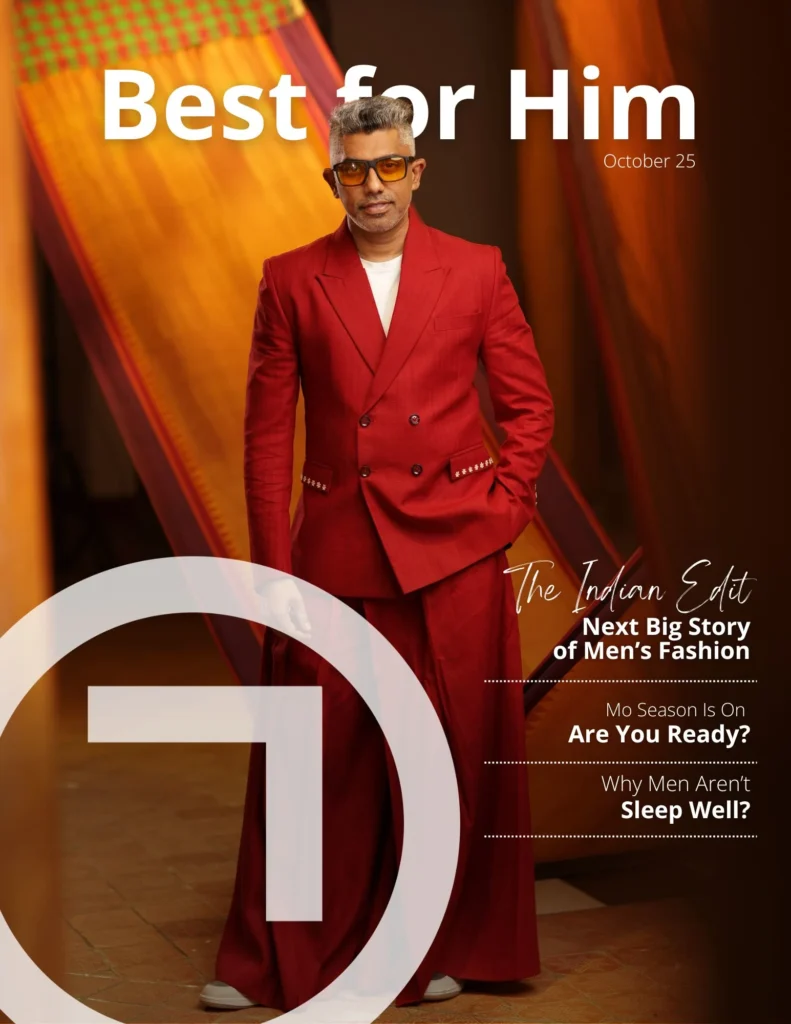
Amid a rapidly evolving landscape, Vivek’s philosophy challenges Indian men to rewrite the rules of personal style—from wearing pastels without hesitation to elevating classics with fresh confidence. His vision is not just shaping fashion—it is shaping how men see themselves.
Vivek Karunakaran is a Chennai-based fashion designer and founder of his eponymous label, Vivek Karunakaran. An alumnus of the National Institute of Fashion Technology, he has spent over two decades shaping a distinctive voice in the Indian fashion fraternity. His design philosophy lies at the intersection of cultural heritage and contemporary relevance – rooted in South Indian traditions yet globally resonant. Widely recognized for redefining Indian fashion, Vivek seamlessly blends handwoven textiles, Indian craft and impeccable detailing with modern tailoring. His work often reimagines Indian classics, – whether it’s the veshti, bandhagala and kurta in menswear, or the sari and draped silhouettes in womenswear – giving them sharp, versatile forms that speak to today’s global audience. Over the years, his collections have been celebrated for their craftsmanship, storytelling and innovative approach to design. From dressing India’s style leaders to showcasing collections inspired by Tamil poetry, temple architecture and cultural nostalgia, Vivek has consistently explored the depth of identity through fashion. Beyond clothing, he views fashion as an immersive experience – collaborating with musicians, artists and craftsmen to create dialogues that extend beyond the runway. Known as a trailblazer in personal style himself, Vivek has also been recognized on GQ India’s Best-Dressed list, embodying the very elegance and innovation he brings to his collections. As he builds toward a global presence, Vivek remains committed to sustainability, inclusivity and cultural pride – championing Indian fashion, both menswear and womenswear as a powerful expression of individuality and timeless style.
How do you define the essence of men’s fashion today, and how has it evolved in the last decade?
Men’s fashion today is about individuality and self-expression. Over the last decade, we’ve seen men move away from rigid stereotypes embracing softer silhouettes, experimental layering and an openness to color and texture. The shift has been from dressing for society’s expectations to dressing for one’s own identity.
Many men struggle to find their personal style what’s your advice for someone trying to build a versatile wardrobe?
Start with honesty. Understand your lifestyle, your comfort levels and what truly excites you. Build a foundation of versatile classics – well-tailored shirts, neutral trousers and sharp jackets and then layer in pieces that reflect your personality. A versatile wardrobe is not about owning too much, but about having the right mix and the magic you can bring about with that mix.
What are some timeless fashion staples every man should own?
A crisp white shirt, a navy blazer, a classic shaket, a well fitted sleeveless bandi, a pair of well-fitted denims, a tailored black suit, a pathan kurta, classic leather shoes and ofcourse a veshti. These pieces are timeless because they can be styled in countless ways while always making a statement.
How do you see Indian men embracing colors, fabrics and silhouettes that were earlier considered unconventional?
There’s been a huge shift over the last 10-12 years I would say. Men are no longer afraid of pastels, drapes or handwoven textiles. They are beginning to understand that fashion is not about rules. it’s about owning the look. The younger generation, especially, sees unconventional choices as a mark of individuality.
You are known for blending Indian aesthetics with modern cuts – how do you balance cultural heritage with global trends?
For me, it’s not so much about balancing heritage with trends – it’s about living them both. I grew up surrounded by the richness of South Indian culture: the textures of veshtis, the rhythm of temple architecture, the poetry of Malayalam literature. At the same time, my journey as a designer exposed me to global conversations in fashion. Both worlds are a part of who I am. So when I design, it’s instinctive. I don’t sit down to “mix” the two – I create from a place of memory and experience. A veshti may find its way into a sharply tailored jacket, or a handloom weave may be cut into a silhouette that could walk into any international space. It feels natural, because I’m simply translating my own identity onto fabric.Global trends come and go, but cultural heritage is timeless. The magic happens when you allow them to flow into each other, creating something that feels rooted yet relevant, familiar yet new.
Do you think men’s fashion in India is moving toward more experimentation, or are we still rooted in classic styles?
I would like to believe that somehow both coexist beautifully. From our conditioning – we are deeply rooted in the classics – the tailored shirts, veshtis, the bandis and the bandhgalas – but today I feel – men are willing to reinterpret them. Experimentation is no longer a rebellion; it is a new form of classic.
Can cultural fusion in clothing be a way for men to express their individuality without losing touch with tradition?
Absolutely. Fusion allows us to carry forward our heritage in a way that feels relevant today. A veshti with a jacket, or handloom paired with sneakers is so cool .. I really believe that it’s not dilution, it’s evolution.
How closely do you think fitness and body confidence are linked to fashion choices for men?
Confidence matters more than fitness. Style is all about how you carry yourself. A well-designed garment should work for the wearer, not against them. I always believe that it’s always about how one feels wearing the garment..Body confidence comes from feeling seen and respected in what you wear.
Do you design keeping different body types in mind, or do you think fashion should adapt to the wearer rather than the other way around?
Fashion must adapt to the wearer. Every body tells a story. My role as a designer is to create clothes that enhance, not hide, that story. Inclusivity in design is non-negotiable. We design for “real people” and the truth is that real people come in all shapes , sizes and proportions.
What are your top tips for men to dress sharply for both professional and casual settings while staying comfortable?
I’ve always felt that style & comfort rarely coexist – you usually have to lean into one more than the other. Personally, I often choose style, because for me clothes are an extension of identity and that sharpness matters. A well-cut jacket or a perfectly tailored trouser may not be as comfortable as a pair of joggers, but it sets a tone and personally I enjoy that discipline.That said, I also know when to let comfort lead. On long days in the studio, I’ll reach for breathable linens or a simple veshti—it keeps me at ease without compromising on presence. For me, it’s about being intentional. At work meetings or public appearances, I’ll tilt toward style; at more intimate or creative spaces, comfort takes over. My advice to men is this: understand your context and make a choice. Don’t expect style and comfort to always blend seamlessly. Instead, learn how to switch gears. When you show up in a sharp, structured look, own it. When you choose relaxed comfort, elevate it with a touch of detail. That balance – knowing when to choose – is where real personal style begins.
Fashion is a demanding industry—what practices or habits help you keep your creativity at its peak?
For me, creativity doesn’t come from chasing fashion alone. It comes from stepping outside of it. I draw energy from the world around me: the beautiful conversations I may have people I meet, the quaint streets of a city, the colors of everyday life, a fragment of literature or even the silence of being with nature and animals. These moments ground me and often spark the ideas that later become collections.Another practice I try to constantly both, inculcate and hold on to – is Discipline. The industry is fast-paced and demanding, but having a structure to my day – whether it’s spending time with my team, sketching at the same desk or revisiting old inspirations – keeps me centered. I also make it a point to constantly engage with craftsmen. Their skills, their stories and their way of looking at the world remind me why I design in the first place.Most importantly, Im learning how to pause. I’ve learned that creativity needs space to breathe – it cannot thrive when you’re always in motion. Giving myself that pause, even if it’s just an evening of music or time with my family at home, a short trip someplace with friends, spending time with my pets – helps me return to my work with fresh perspective.
Where do you draw inspiration from when creating collections for men?
Almost anyplace that at particular point inspired me.. I’m very impulsive..it can be a culture, architecture, poetry, the streets of a city, a way of life, travel… It’s a never ending list (and that’s what it should be) Inspiration is everywhere – it’s about seeing connections between the past and the future and reimagining it a way that celebrates it.
Do you believe collaborations with other creative fields—music, fitness, art—help fuel your design process?
I’ve always believed deeply in the power of collaboration – when different creative forces come together, the outcome is far greater than the sum of its parts. Whether it’s music, art, food or even fitness, these exchanges of energy and perspective fuel my own design process in unexpected ways. This philosophy is very close to ADAYALAM, (the travelling festival I e conceptualized & curated – which debuted at Chettinad Heritage Festival) where collaboration itself became one of the key elements. It wasn’t just about fashion – it was about bringing together multiple disciplines to create a larger cultural conversation. That, to me, is where real strength lies.
In an era of fast fashion, how can men stay stylish while being mindful of sustainability?
Choose quality over quantity. Please Support local artisans and local businesses in every way you can. Reimagine what you already own. I believe true style is timeless and it doesn’t demand constant consumption. Sustainability is not just a responsibility, it is an aesthetic choice. Be as much mindful as u can be.
What’s your vision for the future of men’s fashion in India and its impact on the global fashion?
I see Indian men embracing their roots with a new sense of confidence – bringing elements of tradition into their wardrobes while staying conscious about sustainability. The revival of handwoven fabrics and Indian craft will play a central role, not just as heritage but as a modern style statement with global relevance. The future of Indian men’s fashion isn’t about imitation; it’s about leading the conversation by presenting our culture as aspirational on the world stage.
