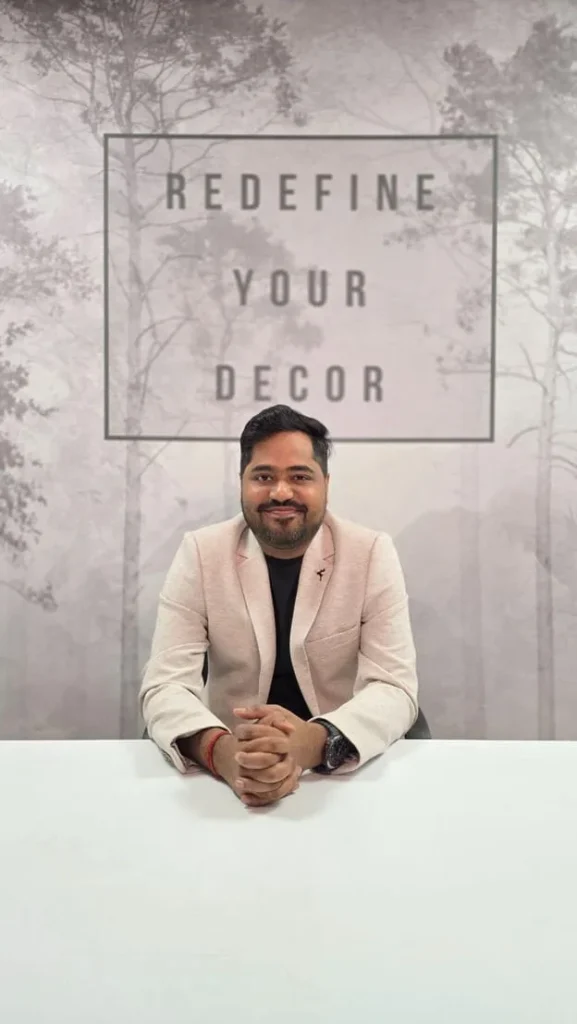
Siddheshwar Panda, Co-Founder & CEO of MagicDecor, began his entrepreneurial journey from a college hostel in Bhubaneswar with just ₹15,000. His first venture, Printview, started as a ₹1-per-page printing service for students and grew into Odisha’s first student-focused printing platform, eventually reaching ₹1 crore ARR. The experience instilled in him resourcefulness, operational discipline, and a deep customer-first mindset.
Driven by a desire to build something transformative, Siddheshwar later entered the traditional home décor industry with MagicDecor, inspired by the potential of large-format printing and personalised wall design. Launching in February 2020—just before the pandemic—posed immediate challenges. Instead of retreating, the team strengthened their technology, built advanced visualisation tools, and developed a zero-inventory custom manufacturing model.
Backed by Pidilite Ventures, MagicDecor is now scaling as a tech-enabled, design-led brand. Siddheshwar defines modern leadership as a balance of resilience and empathy, emphasizing quiet confidence over aggression. Looking ahead, he envisions MagicDecor evolving into a global, AI-powered surface design platform—making personalised décor the default choice for modern spaces.
Before MagicDecor, you built Printview from your college hostel with just ₹15,000. Can you take us back to those early days and how that journey shaped you as an entrepreneur?
Printview began in my college hostel in Bhubaneswar with an investment of just ₹15,000. At the time, it was simply about solving a very real problem- students needed affordable, reliable printing, and there was no structured solution catering specifically to them. What started as ₹1-per-page printing gradually evolved into Odisha’s first student-focused printing platform.
Over the years, we scaled it into a full-service platform, expanded operations, and even received invitations to speak at international forums in Israel and Singapore, which was fully sponsored and a proud moment for us. But more than growth or recognition, Printview taught me the fundamentals of entrepreneurship: resourcefulness, customer obsession, operational discipline, and the courage to build from scratch.
That journey laid the foundation for everything that followed, including MagicDecor. It showed me that you don’t need perfect conditions to start, you need clarity of the problem and conviction of execution.
MagicDecor has made waves in the home décor space. What inspired you to enter an industry dominated by traditional players?
I realised the Indian décor market, especially walls and surface decoration, was still operating with generic products and traditional mindsets. Most homes treated walls like an afterthought, even though they are the largest surfaces in a space. I visited an HP Centre of Excellence in Singapore, saw large-format printing up close, and it hit me, custom, premium wall décor could redefine the way people personalise their homes. That was the seed that grew into MagicDecor.
You dropped out of a B.Tech programme to pursue this vision. What made you take that leap? Was there a moment of clarity?
Dropping out was not an impulsive decision; it was a deeply considered one. By the time I made that choice, I had already built a 1 crore ARR business through Printview. On paper, it was working. It was profitable. It was growing. But I kept asking myself a harder question- Is this the legacy I want to build over the next twenty years?
I realised I was operating within a model that solved a problem, but it did not excite me at a deeper level. I have always been driven by the idea of creating something transformative, something that changes how people experience everyday life. When I discovered the potential of personalised wall décor and large-format printing, it felt like a far bigger canvas, literally and metaphorically.
The moment of clarity came when I understood that comfort can quietly limit ambition. Staying back would have been the safer choice. But entrepreneurship, at least for me, has never been about safety; it has been about conviction. I chose to leave not because education lacked value, but because I had found a direction that demanded my full commitment. MagicDecor was not just a business idea; it was a long-term vision worth betting everything on.
What challenges did you face early on with MagicDecor, especially launching right before the pandemic?
Launching MagicDecor in February 2020 felt like stepping into a storm without knowing it. Within weeks, the pandemic brought everything to a halt, supply chains froze, and uncertainty overshadowed every plan we had made. For a young brand in a traditionally offline category like home décor, it could have been the end before a real beginning.
But crises have a way of revealing clarity. Instead of retreating, we used that period to rebuild from the inside out. We invested heavily in strengthening our technology backbone, created advanced visualisation tools that allowed customers to see designs on their own walls digitally, and refined our in-house manufacturing to enable true custom, zero-inventory production.
While the market paused, we prepared. What initially felt like devastating timing turned into our biggest structural advantage. By the time demand began to return, we were not just another décor brand; we were a tech-enabled, personalised design platform built for a new, more digital-first consumer.
Many men are taught to appear certain, even when they’re unsure. During your lowest moments, especially launching before the pandemic, how did you deal with doubt privately?
There is a silent pressure on men to always look composed, especially when you are leading a company. When we launched right before the pandemic, uncertainty was everywhere. Revenues stalled, supply chains froze, and there were moments when I genuinely questioned whether the timing had destroyed something we had worked so hard to build.
Privately, doubt does not disappear just because you are a founder. I dealt with it by narrowing my focus. Instead of thinking about survival in grand terms, I focused on the next decision, the next improvement, the next process to optimise. Discipline became my coping mechanism.
I also realised that certainty is overrated. What matters more is clarity of intent. I did not always know how things would unfold, but I was clear about why we started. That clarity helped me sit with doubt without letting it define me. Strength, I have learned, is not the absence of fear; it is the ability to move despite it.
MagicDecor isn’t a generational business. As a young son choosing an unconventional path, did you ever feel the pressure of proving yourself, to your family, or to yourself?
When you step outside a conventional career path, there is an unspoken weight that comes with it. In many Indian families, stability is valued deeply- a degree, a secure job, predictability. Choosing entrepreneurship, especially after dropping out, naturally raises questions.
The pressure was less about external judgment and more internal. I did not want to disappoint the people who trusted me. My parents gave me the freedom to choose, and that freedom itself became a responsibility. I felt I had to justify that belief through discipline and results.
Over time, I realised that proving yourself is not about impressing others, it is about staying accountable to your own standards. MagicDecor is not a family legacy business, but it carries my personal legacy. That sense of ownership pushes me far more than any external expectation ever could.
The home décor industry, particularly wallpapers and custom design, can be operationally complex. How did you build a scalable model?
Operational complexity was one of our biggest initial obstacles. Most manufacturers weren’t willing to produce small personalised batches. So we built everything from the ground up, design to dispatch, ensuring we could deliver highly bespoke products without huge inventories. It wasn’t easy, but this helped us keep quality high, turnaround time competitive, and the experience personalised.
Recently, MagicDecor raised funding from Pidilite Ventures. How do you see this partnership accelerating your vision?
The investment from Pidilite Ventures goes far beyond capital; it represents strategic validation from a brand that deeply understands innovation and the Indian home improvement ecosystem. For us, this partnership is about long-term alignment rather than short-term acceleration.
Pidilite brings decades of expertise in adhesives, surfaces, and distribution, which directly complements our ambition to build India’s most trusted personalised décor platform. With their backing, we are strengthening our manufacturing capabilities, advancing our technology stack with deeper AI integration for design personalisation, and expanding our reach across both online and offline channels.
More importantly, it allows us to scale with stability. When a legacy player believes in your vision, it reinforces that you are not just building a product, you are shaping a category. This collaboration gives us the confidence to move faster and position MagicDecor not just as a D2C brand, but as a long-term design-led company with global aspirations.
What’s one misconception about running a design-led D2C brand that you’d like to correct?
An early belief was that bespoke décor couldn’t work online, couldn’t be mass-adopted, wasn’t scalable, and that Indian consumers weren’t ready for it. We heard that the market wasn’t big enough, that wallpaper isn’t something people buy without seeing it in person. But those assumptions underestimated the hunger for personalised spaces. When you empower a customer with visualisation tools and offer quality they trust, the experience becomes compelling.
How would you describe your leadership style and the culture you’re building at MagicDecor?
My leadership philosophy centres on curiosity and resilience. We encourage experimentation and ownership within the team, and we’ve built a culture that rewards learning from failure as much as celebrating success. Our goal is to nurture a team that feels both empowered and deeply connected to our mission of redefining spaces.
As a founder in your thirties building in design industry, how do you define modern masculinity in business today? Is it aggression, resilience, empathy, or something else entirely?
I believe modern masculinity in business has evolved. Earlier, leadership was often equated with dominance or aggression. Today, I think it is defined more by balance.
Resilience is important; entrepreneurship will test you repeatedly. But resilience without empathy can create a brittle culture. In a creative, design-led business like ours, understanding people, your team, your customers, their emotions, and aspirations is equally critical.
To me, modern masculinity in business is quiet confidence. It is the ability to listen without feeling threatened, to admit mistakes without losing authority, and to build with long-term integrity rather than short-term ego. Strength is not about being the loudest voice in the room. It is about being steady when others are uncertain.
Tell us about a failure or setback that taught you a valuable lesson.
There were countless rejections early on, from investors to customers hesitant about online custom décor. One of the biggest setbacks was operational friction & adoptability: building a supply chain that could handle custom workflows quickly and with high quality. But every time we reengineered a process, we learned something new about customer behaviour, production efficiencies, or design optimisation. Those lessons now inform how we scale.
What’s next for MagicDecor? Where do you see the company and yourself in the next five years?
Our larger ambition is to shift personalised décor from being an optional luxury to becoming the default way people design their spaces. Over the next five years, we want MagicDecor to evolve from a wallpaper brand into a comprehensive surface and spatial design platform, expanding across categories while staying rooted in customisation and quality.
Technology will play a central role in that journey. We are investing deeply in AI-led design intelligence that can understand individual preferences, architectural nuances, and lifestyle patterns, making aesthetic decision-making intuitive rather than overwhelming. The goal is to simplify creativity to help people design confidently without needing to be design experts.
Geographically, we see strong potential beyond India. As Indian manufacturing matures and global demand for personalised interiors grows, we want MagicDecor to represent a new generation of Indian design brands on the world stage.
On a personal level, I see myself continuing to build with long-term conviction. I am less interested in chasing trends and more focused on building an enduring brand, one that reflects individuality, empowers creativity, and becomes part of how people tell their stories through the spaces they live in.
If there’s one takeaway from Siddheshwar Panda’s story, it’s this: big dreams don’t need big beginnings—just bold intent, relentless effort, and the courage to build differently. Let his journey remind you that innovation starts where comfort ends, and success belongs to those who dare to create their own blueprint.
