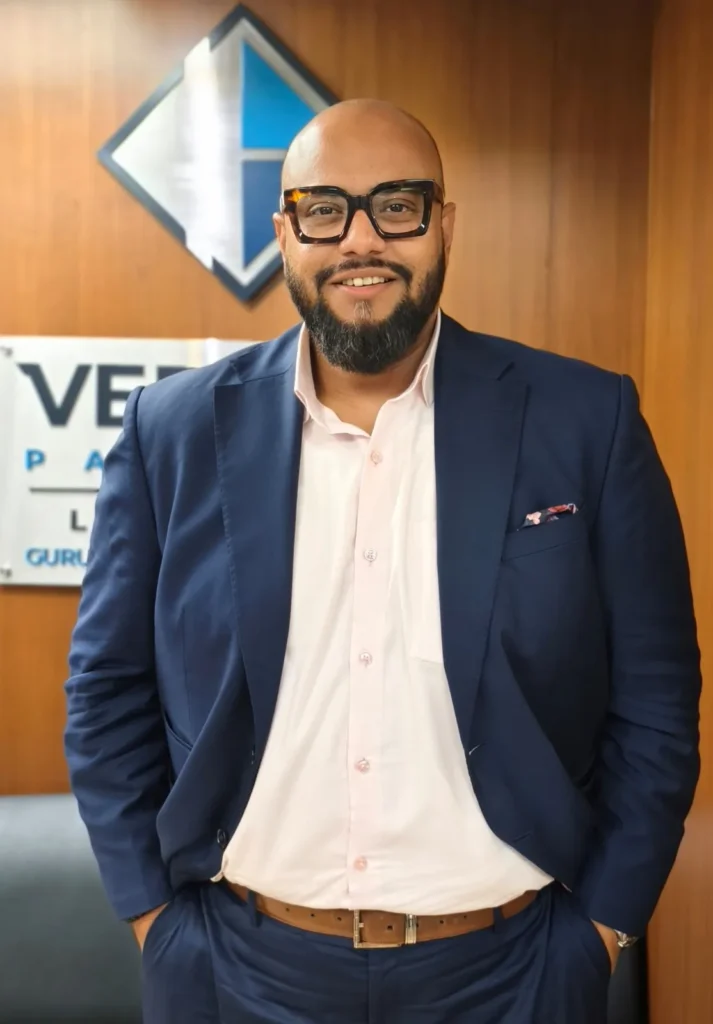
In a world that glamorises startups and overnight success, Vinayak Burman—popularly known as “the founder’s best friend”—offers a grounded and powerful perspective on entrepreneurship. At the heart of his philosophy lies one defining principle, i.e., purpose. Before launching a venture, every aspiring founder must deeply understand their “why.” Without it, the inevitable challenges of entrepreneurship can easily derail even the most ambitious dream.
As a corporate lawyer who thinks like a founder, Burman blends legal sharpness with commercial empathy. He believes law is not just about compliance but about enabling businesses with solution-oriented thinking. The most successful founders he has worked with share a common trait; they prioritise “We” over “I,” leading with humility, trust, and people-first leadership.
Through his podcast, The Lifeboat, Burman amplifies stories of failure and resilience, reminding entrepreneurs that success is built on setbacks. He strongly advocates mentorship, viewing legal and business advice as investments, not expenses.
For Burman, mental toughness comes from balance; tennis, fitness, and storytelling keep him grounded. Ultimately, he backs founders not just for their numbers, but for their DNA—their passion, obsession, and unwavering focus on their North Star.
You are known as “the founder’s best friend.” What do you think every man should know before starting his own venture—something most learn the hard way?
Ans. The purpose. A lot of times people go cross and start something without actually dwelling into the Why and a lot of times you start something on the basis of maybe some kind of a FOMO that people are starting up, people are doing things around you, you want to join that particular bandwagon but you don’t know whether you cut out for the journey, whether you are meant for the journey because the journey is a very difficult one.
So the purpose and the reason as to why you’re starting up is perhaps the most important thing that you should calibrate your mind with because there will be several occasions in your journey where it’ll question you as to why on earth are you even doing this?
But if the purpose is strong, you will be able to stay on the path, If not, it’s very easy to move away from the path.
So why you want to start up and why you want to build something is perhaps the most important answer that an individual needs to know from Day One.
Corporate law isn’t typically associated with creativity, but you’ve built an entrepreneurial brand within it. How do you keep your legal edge sharp while still thinking like a founder?
Ans. Very simple see, the problem is, law needs to also understand that it is a business when it’s in the business of law. For any form of advice, whether it’s legal, whether it’s any other form of advisory business, the role of that business and the role of that person should be of being a facilitator and, importantly, acting as a catalyst and a conduit in terms of the client’s requirements. So when you look at the requirement and try and address it from a solution perspective, you realise that your mind has to be solution-oriented and it has to be always out of the box.
So when you look at these two things together, you perhaps come with solutions, you come with situations, you come with advice which resonates with the founder because you yourself don the entrepreneurial hat. And then you realise that a lot of pain value for founders is very similar across the business, whether it’s a product business, whether it’s a service business doesn’t matter, so your trials, your pain, your tribulations in terms of generating business. Generating pipelines, retaining talent, hiring talent, cost matrixes, everything remains the same.
So as long as you realise that you are advising with a lot of empathy, its easy and people resonate; and for you to stay sharp with what you do at the end of the day as a lawyer, the knowledge is your tool and for a carpenter, the tools have to always be sharp, so to be a lawyer and not be well read up not be updated, not know what the nuances of the legal developments around you is not something that can function.
So, you to wear that hat, along with the hat of a businessman, to say that if you are in the business of law, it has to be advise, but with commerce and empathy at the top of the helm.
You’ve worked with giants like Sugar Cosmetics and DeHaat. What common trait do you see in founders who build sustainable empires – not just unicorns?
Ans. I think the most important trait that I’ve seen with any successful founder, and I’ve been very, very privileged to advise a whole bunch of them, is the common thought process to say that it is always We over I. The biggest mistake in businesses is when the founders somehow realise that it is I over We, and the God Syndrome comes in that particular manner to say that the business is about the founder.
Whereas if a founder realises that the business is about the people and the founder is nothing but a conduit to what he or she is trying to create and will not be able to create that without the people, I think the essence of empathy, the essence of humanity, the very essence of humility comes into play. And any good founder, any founder who has actually built and created something worth, of any value, you will see this common ethos across them to always put themselves in the last of the food chain and everyone else around them in the food chain much ahead.
So I think, as long as a founder operates with that sense of empathy, with that sense of belonging, with that sense of trust and with a sense of developing and taking care of people, it’ll keep growing and that, I think is the biggest strength of a founder – the founder can understand that upfront.
You launched The Lifeboat Podcast as a side project, but it’s now a solid platform for founders. Why do you think storytelling is important for men in business, and how has it changed you?
Ans. So the reason I started Lifeboat as a podcast, it’s also a passion project of my because one of the things that I realised is that everyone is showcasing success and social media has glamorised success at a very large level. Over a large construct where, the younger generation somehow believes that entrepreneurship is equivalent to success.
The reality is that for every successful entrepreneur, there are at least 1000 failed entrepreneurs. So what happens in the Lifeboat is the most successful founders, the most successful investors, the most successful entrepreneurs come and talk about their failures, they come and talk about when they failed, how they failed, and why they failed, and how they resurrected themselves thereafter. So I think that storytelling is very important to create that clarity and to create a recalibration to say that while you want to jump into the ocean of entrepreneurship, do it because it’s not that it’s a hype, or because a lot of people are doing it, or because it’s a trend that you want to follow.
Do it because you don’t have a Plan B; because if you don’t have a Plan B or a Plan C and you do it with a plan A being the only plan, that is when you will give your 110%. Otherwise, there will always be leakage.
So I think storytelling is very important as every founder needs to talk about their story to inspire someone else and the currency of trust, the currency of inspiration, the currency of conversion only happens through stories and stories that are told so the essence of lifeboat is that’s why about stories that keep you afloat.
Men often struggle with asking for help or mentorship. What’s your take on the importance of legal and business mentorship in a founder’s journey and how can we normalize it?
Ans. I think extremely important. One of the things that one needs to realise that there is no shame in asking for help when you start out, you start out in a manner with your thoughts with your ideations. But there’s several things that can go wrong, several things that don’t go as per plan, as per what you think is ideal.
And that’s where sometimes sounding boards are very important and these sounding boards are what are defined in today’s world as mentors and I think it’s extremely normal to feel the need to ask and bounce off ideas without being shamed, judged, or questioned.
Legal and commercial advice are fundamental in terms of any business, because business works on 3 pillars. The essence of commerce, the essence of governance and the essence of legalities.
These 3 pillars are what make a business function in a particular manner. So to my mind, as a founder, one needs to treat this as an investment and not an expense, and I think that is the biggest mindset shift. Most people think advisers or anyone who’s coming in is more of an expense item in your initial days. If the mindset changes to say that it’s an investment which will actually give you a much larger intangible ROI, things will automatically shift, and therefore, to my mind, it’s imperative to have these advices around and imperative to go across and have the right mentors around.
You have to be lucky to get the right mentors. And therefore, there’s no harm in asking out and looking out for the right people.
Your career spans high-pressure legal environments and the startup chaos. How do you maintain mental toughness? Is there a non-negotiable habit or philosophy you live by?
Ans. I think you need to be in pockets of what manages and creates a certain amount of balance parts for you for each one, there are different elements of balance that come into play, and different escape proofs are coming to play. For some. It could be no running, for some; it could be reading a book for someone, it could be hitting the gym for some, or it could be playing a sport.
For me, I think it’s a combination of various things. The passion project of storytelling through my podcast, The Lifeboat, itself is something that gives me an escape, because I think that’s a great way for me to keep a mental balance across what I do, what I build, and what I am. I’m between the frying pan and the fire on an everyday basis.
So I think that’s a great recalibrator for me. I play Tennis about 3 times a week. I think that again is a very big equaliser to go across and create some kind of sanity, check, and sanity balance for me.
I do weight training twice a week. I think that again brings a lot of balance in my mind, in terms of creating some kind of a thought process of saying, continuity is very important.
So for me, this is how I keep my mental wellness well-appreciated and factored in.
I think everyone needs to find their own escape.
In a world that glorifies hustle, how do you personally draw the line between grind and burnout? What advice do you give young men chasing success but losing balance?
Ans. Burning out is something that is bound to happen because burning out is something that comes into play as a result of doing something too fast, too soon to too scalable, and trying to scale too high, but the way to keep things in check is to not lose the passion in what you are doing. As long as you are extremely passionate, of course, taking into consideration the ability to afford to be passionate, because if you have to bother about food on the table, you don’t have the luxury to afford to follow your passion.
But assuming you have the ability to follow your passion and assuming you’re very passionate about what you’re building, you have to keep that mindset that you’re always on the go to say that you’re creating something because you wanted to and try and look at it with that perspective that says it’s not work. If you feel it’s not work on an everyday basis because you’re so passionate about it, the probability ratio of getting burnt out about something that you’re so passionate is extremely low.
So you need to balance it out in terms of doing things in a manner that actually gives you happiness. And hope that the work that you are doing also brings happiness for you. Again, with the disclaimer that you can hopefully afford to chase your passion. Most people in this country coming from the background of where I have come from.
Initially, it’s very difficult to chase passion because you’re only bothered about food on the table, so yeah, if you can afford it, be passionate, and then the question of burning out is extremely rare.
You have spoken about angel investing and mentoring founders. What makes you say yes to a pitch not just legally, but as a man who’s seen it all?
Ans. I think what makes me say yes to the pitch is most important, the quality of the founder, the quality of the person to say that it’s not just about the business or about the numbers or what the numbers and the projections are or what has been showcased as can be or cannot be. It is more about seeing how dedicated, how mad, how crazy, and how completely intrigued and involved is a founder in terms of that vision and whether that founder can go across and look at that with if I may call it equivalent of the curtains and the horse’s eyes not to look left right and only look at the goal and chase the North Star. So if I see that sense, and I believe that the probability ratio of a founder building that pitch is much higher. So for me, the DNA of the individual is far more important than the projections in his deck.
Law, leadership, podcasting—you wear many hats. How do you build authority with a humble mindset, especially in a culture that often equates success with ego?
Ans. I don’t think you should even try to build authority. For me, what happens and what really matters is that at the end of the day, are you creating some kind of an impact, whether tangible or intangible, with your work? And if that impact is genuine, if that impact is tangible, if the impact is also intangible as intangible is far more important than tangible, you touch a lot of people’s lives in some way or the other, and to that extent, authority, I think is something which comes out of respect, that you earn as against respect, that you demand and even the term authority to my mind is an inappropriate term. I think the ability to be a leader is something that comes out of what you bring as your DNA in terms of impacting someone’s life.
Hopefully, with the hats that I wear, I have managed to impact quite a few lives, both tangibly and intangibly, and I guess that’s what’s resulted in me being able to reach, wherever I have reached.
If you could write a “Legal Survival Kit” for the modern male entrepreneur, what are the top three things it would include and why?
Ans. Ensure that you follow all adequate processes in terms of incorporating your company in the most appropriate manner, which basically means that don’t miss out on any of the legalities on the governance-related issues.
If you are a co-founder and you have other co-founders with you, ensure that you have a very solid co-founder’s agreement, which articulates very clearly the roles and responsibilities as well as the liabilities of both parties.
Third and most important, ensure that you have factored in all forms of statutory dues and statutory payments with respect to the company, because one of the biggest things that company in early stage misses out is in terms of things which are statutory dues and as a result that comes in and bites you much later in a much larger manner, because the penalties around that becomes so heavy that you’re trying to tackle a behemoth, like the government in terms of getting those things sorted on your bandwidth or running the business completely shifts.
