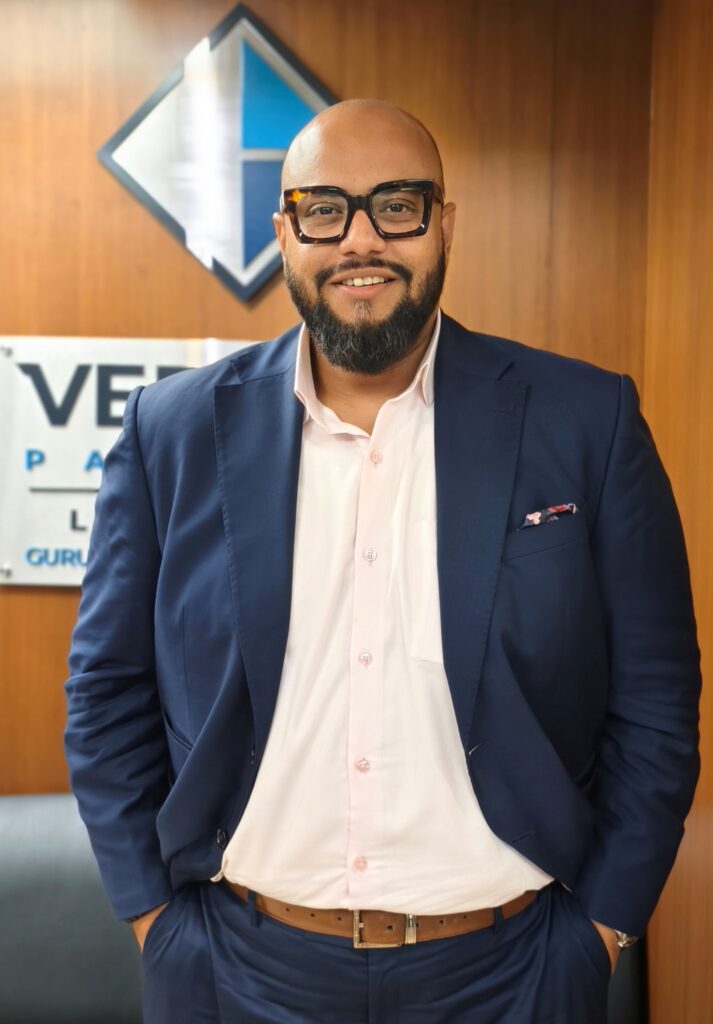
Most founders think they need a lawyer when something goes wrong. Vinayak Burman believes the real value of legal counsel lies much earlier—when difficult decisions are still taking shape and before small mistakes become expensive problems. As the Founder and Managing Partner of Vertices Partners, Burman has built a reputation for being more than a startup lawyer. Over the years, he has become a trusted sounding board for entrepreneurs navigating fundraising, co-founder dynamics, scaling challenges, acquisitions, and the emotional realities of building a business.
That perspective also shapes The Lifeboat Podcast, his platform dedicated to exploring the often-unseen side of entrepreneurship. While headlines celebrate funding rounds, exits, and growth milestones, The Lifeboat Podcast focuses on what happens beneath the surface—the uncertainty, resilience, failures, relationships, and decisions that ultimately determine whether founders stay afloat.
In this conversation, Burman offers a candid look into the realities of entrepreneurship, leadership, and risk. He speaks about the difference between conviction and correctness, why founders often underestimate the human side of leadership, and how legal advice is most valuable when it helps ambition become sustainable rather than simply aggressive. What emerges is a thoughtful discussion on decision-making, resilience, founder psychology, and the lessons that rarely make it into startup success stories.
Most founders treat a lawyer the way they treat an accountant — bring them in when something’s already gone wrong. How did you end up becoming someone the founders call before that?
That shift happened when founders realised I wasn’t treating law as a post-mortem function. Most traditional legal engagement begins after a problem has already surfaced – a dispute, a bad term sheet, a compliance mess, or a falling-out between co-founders. But startups don’t break in one dramatic moment. They usually unravel slowly, through small decisions made without context, without structure, without anyone asking the right questions early enough. Over time, I stopped thinking of my role as protecting a company legally. I started thinking of it as helping founders think clearly while they’re building under pressure.
A founder rarely calls you saying, “I have a legal issue.” They call you saying, “Something feels off with this investor.” “I’m not sure I should trust where this co-founder equation is headed.” “I think we’re scaling faster than we should.” “We have to take this deal. The runway won’t last.”
Those are business conversations before they become legal ones. I think founders started reaching out earlier because they felt they could speak honestly – without being judged, lectured, or slowed down. A startup lawyer cannot operate like a gatekeeper. You must understand ambition, urgency, fundraising psychology, founder ego, fear, and exhaustion, often all at once.
Law matters. But context is what founders actually need. Somewhere along the way, I became less of an external counsel and more of a thinking partner at the moments that actually count.
‘The founder’s best friend’ is a loaded phrase. Friendship implies honesty that’s sometimes uncomfortable. What’s the hardest thing you’ve had to tell a founder who was convinced they were right?
Probably that conviction and correctness are not the same thing. Founders operate in an environment where self-belief is essential. If they were completely rational all the time, most companies would never get built. But once a founder starts winning—raising capital, getting press, and seeing growth—disagreement starts disappearing from the room. One of the hardest conversations I’ve had was with a founder who had convinced himself that aggression was the same as leadership. Internally, the culture was deteriorating. Senior people were leaving quietly. Investors were still excited because the metrics looked fine. But the company was becoming emotionally expensive to build.
What I had to tell him was, “You’re not losing because the market is against you. You’re slowly becoming the reason people stop believing in the company.”
That’s not a legal conversation. That’s a human one. The uncomfortable truth is that most founders don’t fail because the idea was weak. They fail because success amplified the parts of themselves they never learned to manage — ego, paranoia, insecurity, impatience, and control. Sometimes the most useful thing you can do for a founder is not help them close a round faster. It’s helping them see what everyone around them is too afraid to say.
There’s a version of a corporate lawyer who protects founders from risk and a version who helps them take it intelligently. Which one are you, and did you consciously choose that?
Definitely the second. If a startup lawyer’s only job is to say no, they become irrelevant very quickly. The goal isn’t to block ambition — it’s to make ambition durable.
Indian startup law is still catching up to the speed at which Indian startups operate. Where has that gap genuinely hurt founders you’ve worked with?
The biggest gap isn’t just regulatory speed — it’s regulatory imagination. Ambiguity around taxation, foreign ownership, data practices, and evolving business models has slowed founders down at moments when speed actually mattered.
You’re a partner at a law firm and a founder yourself. Do those two identities ever pull in opposite directions — and how do you manage that tension without one compromising the other?
All the time. The lawyer in you wants caution and precision. The founder in you knows that overanalyses kills momentum. That tension has actually made me sharper at both.
A lot of early-stage founders sign term sheets they don’t fully understand because they’re afraid of looking unsophisticated in front of investors. How common is that, and what does it actually cost them later?
Far more common than people admit. Term sheets aren’t just financial documents — they’re control documents. The cost usually surfaces later: during future rounds, in disputes, at exits.
The Lifeboat Podcast — why that name? What’s the metaphor you’re working with, and does it reflect how you see your own role?
News and social media glamorise entrepreneurship from a distance — they show the wins, the milestones, and the stories that ended well. Up close, it looks nothing like that. It’s full of failure, and it’s deeply isolating.
The Lifeboat represents the emotional reality behind what it actually takes to build something. The failures you learn from, the people around you who don’t let you drown. Your philosophies, your convictions, the inner willpower you fall back on when nothing’s working. That’s what keeps you going through uncertainty — not the highlight reel, but the thing underneath it. That’s what the name is about.
Entrepreneurship advice has become an industry of its own — podcasts, newsletters, and accelerators, all selling some version of the same playbook. What does that ecosystem consistently get wrong?
It over-romanticises certainty. Real entrepreneurship is messy, emotional, and nonlinear — not a neat retrospective framework dressed up as strategy.
You’re in rooms where companies are being built and broken. Does that change how you think about risk in your own life, or does exposure to that much volatility make you more conservative personally?
It’s changed my relationship with certainty more than with risk itself. I’ve stopped being arrogant about predicting outcomes. And I’ve become much more deliberate about where I put my time and energy.
If you could go back and give one piece of legal advice to a founder at the exact moment they’re deciding to take their first external cheque, what is it?
Don’t just optimise for getting funded. Optimise for what happens after the money arrives. The quality of the relationship matters more than the headline valuation.
What’s a question no one asks you that you think actually matters?
Nobody really asks: “What kind of founder should not raise venture capital?” Not every good business needs to become a venture-scale business.
Most lawyers are trained to see the downside of everything. That’s the job. But founders need to believe, sometimes irrationally, that it’s going to work. How do you sit in both rooms without killing the optimism that makes the thing possible in the first place?
Optimism and realism aren’t opposites. My job isn’t to drain conviction out of the room — it’s to help conviction survive contact with reality.
You’ve watched a lot of startups up close, the ones that made it and the ones that quietly didn’t. Is there a pattern you’ve noticed that never makes it into the post-mortems?
Most startups don’t die because of one catastrophic event. They die because the people building them become emotionally exhausted long before the company officially fails.
You’ve advised companies like Sugar Cosmetics and Upgrad — very different businesses at very different stages. Does the legal risk profile of a D2C brand look fundamentally different from an edtech, or does it all eventually come down to the same three or four vulnerabilities?
Having advised both D2C brands like Sugar Cosmetics and edtech platforms like upGrad, I have observed that while the legal risk profiles differ in character, they converge on the same core vulnerabilities as companies scale. D2C brands primarily face product-centric risks, like product classification and claims, labelling, ingredient compliance, and product liability, and Edtech companies, on the other hand, deal with service and expectation-driven risks, like misrepresentation (placement assurance), refund disputes, data privacy, and complex IP/content licensing with institutional partners. Therefore, in essence, across both D2C and edtech, the recurring fault lines are consumer protection, data privacy, claims substantiation, and regulatory compliance. In my view, the bottom line is that while the early risks may vary by sector, as companies scale, their performance depends on the same core values of robust consumer policies and proactive compliance.
Fritternity got acquired by CureFit. From the outside, an acquisition looks like a win. What actually happens inside the room when that deal is being negotiated, and what do founders routinely underestimate about that process?
From the outside, execution of the term sheet for acquisition looks like a defining milestone achievement; however, once you are inside the room, when the deal is negotiated, the founder realises it is far more complex, emotional, and operationally intense. The headlines usually talk about valuation and strategic fit, but the real conversations are around control, risk allocation, liabilities, founder continuity, culture integration, and whether the business can actually survive and scale within a larger ecosystem.
A lot of founders believe that once the commercial terms are agreed, the difficult part is over. In reality, that is when the real work begins. Every clause starts mattering; for instance, representations, warranties, indemnities, earn-outs, founder lock-ins, ESOP treatment, employee retention, tax exposure, IP ownership, and data compliance – all these become central discussion points. Something that may have seemed operationally insignificant during the startup journey can suddenly become a material diligence issue during acquisition discussions. Founders often underestimate how much time is spent cleaning historical records, aligning documentation, and resolving legacy issues before a transaction can close.
Many founders tend to focus extensively on growth metrics and business expansion, while underestimating the importance of operational and legal discipline until they enter an actual transaction process. Critical elements such as strong governance practices, clean and organised documentation, transparent reporting systems and disciplined compliance frameworks often become significant value drivers and provide substantial leverage during acquisition discussions, yet these aspects are frequently overlooked in the early stages of building the business.
Throughout the conversation, Mr. Vinayak Burman highlights a truth often overlooked in startup culture: businesses are ultimately built by people, and people are shaped by the decisions they make under pressure. Whether discussing leadership, fundraising, legal strategy, or founder resilience, his perspective consistently returns to the importance of clarity, self-awareness, and sustainable growth. It is a reminder that enduring success is rarely about moving faster—it is about thinking better.
